Direct Answer: Use ChatGPT, Claude, Gemini and other AI tools confidently and safely for writing, research, studying, office work, images, business and everyday tasks, with no technical background needed.
Tuition Fee
100% Free
Duration & Workload
~10 Hours
Curriculum Depth
12 Chapters · 48 Lessons
Credential Awarded
Verified Certificate
12Chapters
Course outline
Learn what generative AI can and cannot do, how chatbots such as ChatGPT, Claude and Gemini produce their answers, how to pick the right tool for a task, and how to decide whether a paid plan is worth it.
What Generative AI Is and Is Not12 min
How Chatbots Like ChatGPT, Claude and Gemini Work13 min
Choosing the Right AI Tool for a Task12 min
Free Versus Paid Plans and What You Actually Need13 min
Write prompts with a clear task, context, format and constraints, give examples that guide the style, improve results through conversation rather than one-shot requests, and build a personal library of reusable prompt templates.
The Anatomy of a Good Prompt13 min
Giving Context, Examples and Constraints13 min
Iterating: Conversations, Not One-Shot Requests12 min
Prompt Templates for Everyday Tasks13 min
Use AI to draft clear emails and professional messages, structure reports and proposals, edit tone and translate between English and Urdu, while keeping your writing authentic and in your own voice.
Emails and Professional Messages13 min
Reports, Proposals and Documents13 min
Editing, Tone and Translation12 min
Keeping Your Own Voice13 min
Use AI as a patient tutor to learn anything faster, research with sources you can verify, recognise and catch hallucinations before they cause harm, and summarise long documents, lectures and videos accurately.
Using AI to Learn Anything Faster13 min
Research With Sources and Citations14 min
Checking Facts and Spotting Hallucinations13 min
Summarising Long Documents and Videos12 min
Use AI with spreadsheets and data, turn meetings into notes and action items, build presentations faster, and plan tasks, projects and schedules so that everyday office work takes less time.
AI in Spreadsheets and Data13 min
Meetings, Notes and Action Items13 min
Presentations and Visual Documents12 min
Planning Tasks, Projects and Schedules13 min
Create images from text descriptions, edit photos and designs with AI features, use transcription, voice and text-to-speech tools, and understand what AI video tools can do, always with honesty about AI-generated media.
Creating Images With AI13 min
Editing Photos and Designs12 min
Voice, Transcription and Text to Speech13 min
AI Video Tools12 min
Study with AI in ways that build real understanding rather than shortcuts, prepare for exams with practice questions and feedback, help teachers plan lessons and materials, and follow academic integrity rules and school policies.
Studying With AI Without Cheating13 min
Exam Preparation and Practice Questions13 min
Lesson Plans and Materials for Teachers12 min
Academic Integrity and School Policies13 min
Create marketing content and social media posts faster, handle customer messages with consistent quality, write product descriptions that sell honestly, and use AI to deliver freelance work faster without losing quality or trust.
Marketing Content and Social Media13 min
Customer Service and Replies13 min
Product Descriptions and Online Selling12 min
Freelancing Faster With AI13 min
Get help with code safely as a beginner, write spreadsheet formulas and simple scripts with AI, automate repetitive tasks with no-code tools, and build simple custom assistants for recurring needs.
Getting Help With Code as a Beginner13 min
Spreadsheet Formulas and Simple Scripts12 min
No-Code Automation With AI13 min
Building Simple Custom Assistants13 min
Protect your private information when using AI tools, recognise AI-powered scams, deepfakes and misinformation, understand bias in AI outputs, and handle copyright, ownership and disclosure responsibly.
What Not to Share With AI Tools13 min
Scams, Deepfakes and Misinformation14 min
Bias and Fairness12 min
Copyright, Ownership and Disclosure13 min
Get good results from AI in Urdu and Roman Urdu, apply AI to everyday family and business needs in Pakistan, use AI to make information more accessible and inclusive, and understand the limits of AI with local languages and local knowledge.
Using AI in Urdu and Roman Urdu13 min
Everyday Uses for Pakistani Families and Businesses14 min
Accessibility and Inclusion12 min
Limits With Local Languages and Knowledge13 min
Build a personal AI workflow that fits your daily life, evaluate new AI tools with a simple checklist, understand which careers and skills are growing in an AI world, and stay current without being overwhelmed by constant change.
Building a Personal AI Workflow13 min
Evaluating New AI Tools12 min
Careers and Skills in an AI World13 min
Staying Current Without Overwhelm13 min
Final exam & certificate
01
Topic checks
Each one opens the next topic
02
Chapter quizzes
Each one opens the next chapter
03
50-question final
50 of 100 marks to pass
04
Certificate
Issued instantly, verifiable
One attempt, 60 minutes. If you don't pass, you can retake once after 30 days.
The course guide
Learn How to Use AI Tools for Free: A Beginner's Plan
16 October 2026 · 10 min read
You can learn how to use AI tools for free by picking one general chatbot, such as ChatGPT, Claude or Gemini, on its free plan, and using it every day for real tasks you already do: an email, a summary, a study question. Learn to write a clear prompt, learn to check what comes back, and learn what never to paste in. That is most of the skill. Paid plans, fancy apps and "100 AI tools" lists can wait.
This guide gives you a 4 week plan, the habits that separate useful AI use from wasted time, and an honest look at our free course, AI Tools for Everyone, which takes a complete beginner through all of this in 48 short topics.
What "using AI tools" actually means
Generative AI creates new text, images, audio or video from patterns it learned from huge amounts of existing examples. The catch is that a chatbot predicts likely words. It does not look facts up unless search is switched on, and its knowledge stops at a training cutoff, so it can sound completely confident and still be wrong. That is called a hallucination, and every good habit below exists because of it.
So "knowing how to use AI" really means three things:
Asking well, so the first draft is close to what you need.
Checking well, so a confident mistake never reaches your boss, teacher or customer.
Sharing carefully, so your private information stays private.
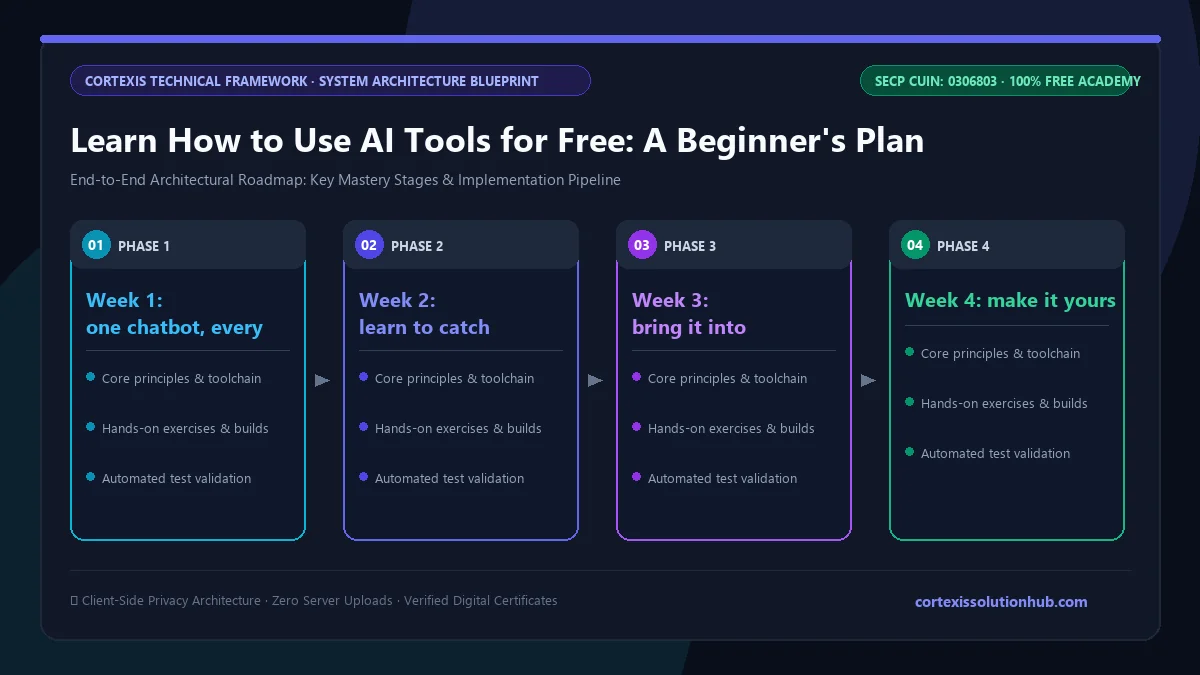
Figure 1: Complete step-by-step architectural workflow and technical execution stages for Learn How to Use AI Tools for Free: A Beginner's Plan.
Which free AI tool should you start with?
Start with one general chatbot and the AI features already inside apps you use. For most people that covers nearly everything.
What you want to do
A sensible starting point
Write, explain, brainstorm
A general chatbot such as ChatGPT, Claude or Gemini
Research with sources you can open
A chatbot with web search, or a search focused tool such as Perplexity
Work inside Word, Excel, Gmail or Docs
Built in assistants such as Microsoft Copilot or Gemini in Google Workspace
Social posts and flyers
Canva with its AI features
Short video edits
CapCut and similar apps
Before signing up, ask: does an app I already use do this, does it handle Urdu and Roman Urdu well enough, and what happens to the data I type in?
Free plans have usage limits. Paid plans are normally priced in US dollars, so the rupee cost moves with the exchange rate and your bank may add a fee. Decide after a month of real use, not before.
If you want something that runs on your own computer with no account at all, we wrote about a free offline AI assistant too.
How to write a prompt that works
A weak prompt is one vague line. A good prompt has four parts: the task, the context, the format you want, and any constraints.
Compare these two:
Weak:  write an email to my landlord

Better: Write a polite, short email to my landlord asking him to fix
the water pump, which has not worked for three days. I rent the ground
floor. Keep it under 120 words, friendly but firm, in simple English.
The second one says what happened, how long and what tone. You get something you can send after a quick read.
Three more habits make a big difference:
Give an example. If you want product descriptions in a certain style, paste one you like and say "match this style".
Ask for a format. "Use a table with price, data, minutes and validity as columns" beats "compare these packages".
Treat it as a conversation. If the first reply is close but not right, do not start over. Ask for specific changes: "shorter", "less formal", "keep the second paragraph, rewrite the first".
When a prompt works, save it in a small library organised by task. If prompting itself interests you, our Prompt Engineering course goes much deeper.
A 4 week plan to learn AI tools for free
Spend 20 to 30 minutes a day on real tasks from your own life, so the skill sticks.
Week
Focus
Daily practice
Week 1
One tool, clear prompts
Rewrite one real message or email with AI, then edit it in your own words
Week 2
Research and checking
Ask a factual question, then confirm the answer in a source you open yourself
Week 3
Work and study
Summarise a document, build a spreadsheet formula, or make revision questions
Week 4
Safety and your own workflow
Decide which tasks get which tool, and write down what you will never share
Week 1: one chatbot, every day
Pick one tool and stay with it. Use it for things you would do anyway: a WhatsApp reply to a customer, a cover letter paragraph, a topic from class. Change anything that does not sound like you.
Week 2: learn to catch mistakes
The week most people skip, and the most important. Ask for facts, then check them. Chatbots have produced convincing citations to articles that do not exist, so cite only sources you opened and read yourself.
Week 3: bring it into real work
Summarise a long document and check the points against the original. Describe your columns and ask for an Excel or Sheets formula, then test it on a small sample. Students can ask for practice questions on a chapter after reading it, not instead of reading it.
Week 4: make it yours
Write down which tool you use for which task. Add custom instructions about your background and preferences. Then write a "never share" list: passwords, one time banking codes, CNIC numbers, salary sheets, other people's private details.
Mistakes to avoid when you start
Trusting a confident tone. A precise looking statistic in an AI draft is a warning sign, not proof. Remove it, or use only figures you supplied.
Pasting sensitive data. Strip names, CNIC numbers and amounts from a spreadsheet before asking for help with it.
Chasing every new app. A few tools assigned to regular tasks beats changing tools every week.
Letting it think for you. Use AI for explanations and feedback, do the thinking yourself, and follow your school's or employer's rules.
Falling for AI scams. Voice cloning and deepfakes make fake emergencies more convincing. If a "relative" calls asking for money urgently, hang up and call them back on the number you know.
What the free AI Tools for Everyone course covers
The AI Tools for Everyone course is a beginner course with no technical background needed. It has 12 chapters, each with four topics, so 48 topics in all, and each topic is a 12 to 14 minute read with its own short quiz.
Chapter
What you learn
1. Understanding AI Tools
What generative AI is and is not, how chatbots like ChatGPT, Claude and Gemini work, choosing a tool, free versus paid plans
2. Prompting That Works
Task, context, format and constraints, examples, iterating in conversation, reusable templates
3. Writing and Communication
Emails, reports and proposals, tone and English to Urdu translation, keeping your own voice
4. Research and Learning
Learning faster, research with sources, spotting hallucinations, summarising long documents and videos
5. Productivity at Work
Spreadsheets and data, meetings and action items, presentations, planning tasks and schedules
6. Images, Audio and Video
Creating and editing images, transcription and text to speech, AI video tools, honest labelling
7. AI for Students and Teachers
Studying without cheating, exam practice questions, lesson plans, academic integrity
Code help for beginners, formulas and simple scripts, no code automation, simple custom assistants
10. Safety, Privacy and Ethics
What not to share, scams and deepfakes, bias, copyright and disclosure
11. AI in Urdu and Pakistani Contexts
Urdu and Roman Urdu prompting, everyday family and business uses, accessibility, local language limits
12. Your AI-Powered Future
A personal workflow, evaluating new tools, careers and skills, staying current without overwhelm
Chapter 11 is the one most global courses lack: what AI does well in Urdu, where it struggles, and prompts like "keep technical terms in English where Pakistanis normally use English".
Who it is for
Students, teachers, office workers, shopkeepers, freelancers and parents who want to use AI properly without coding. If you already use ChatGPT daily and want to build automations or agents, look at AI Automation and Agents instead.
How long it takes
The reading adds up to roughly ten hours across the 48 topics. The course is planned as 4 weeks, which matches the plan above. Each topic needs at least 90 seconds of reading before its quiz unlocks, and you need 70 percent on a topic quiz to open the next topic, so you cannot skip ahead by guessing.
How the free certificate works
The certificate comes from a final exam of 50 questions in 60 minutes. You need 50 out of 100 marks to pass. You get one timed attempt, and if it does not go well, one retake after 30 days with the same questions in a new order and the options shuffled. Leaving the exam tab, even to switch apps, submits it, so sit it when you have a quiet hour. Whether a free certificate helps your CV depends on how you use it, which we cover in are free online certificates worth anything.
Questions, answered
06 questions
Yes. The free plans of the main chatbots are enough to learn every core skill: prompting, checking answers, summarising and drafting. Our course is free too, including the certificate.
No. You type requests in plain English, Urdu or Roman Urdu. Even the course's automation chapter is written for non programmers.
All three handle everyday writing and explaining well, and quality changes with each new model. Try the same real task in two of them for a week and keep the one whose answers you edit least.
Mostly, for everyday tasks. Understanding questions, simple translation and Roman Urdu chats usually work well. Poetry, idioms, formal legal Urdu and Urdu text inside AI images are weak spots, so check those carefully.
It depends on your institution's rules and how you use it. Having AI explain a topic or quiz you is studying. Submitting its writing as your own, or using it in an exam, is not.
With 20 to 30 minutes of real practice a day, most beginners feel confident within about a month. The [free AI Tools for Everyone course](/learn/ai-tools-for-everyone) follows the same 4 week pace, so start today and use it on one real task before you close the tab.