
The request/response cycle, and the markup and styling every page is built from.
- The Request/Response Cycle12 min
- HTML That Means Something12 min
- CSS Layout Without the Guesswork14 min
- URLs, DNS, and HTTPS12 min
12 free chapters and a certificate anyone can verify.
Read the guide: How to become a full stack developer: a free roadmap

Direct Answer: Go from raw HTML to a deployed application with a React front end, an Express API, and a real database behind it.
The request/response cycle, and the markup and styling every page is built from.
The language features you actually reach for when building real software.
Components, state, and effects — the mental model behind every React app.
The back end: routing, REST design, validation, and honest error handling.
Persisting data, authenticating users safely, and getting the whole thing online.
Proving which layer a bug lives in, and the two kinds of test that stop it coming back.
Making the stack fast once there is real data in it, and running it safely after launch.
Pushing updates to the browser as they happen, and keeping every server instance, every open tab, and every flaky connection in agreement.
The attacks that still work against an application that already hashes passwords, and the defences that close them.
Keeping data true when two users, two tabs, and two retries all arrive at the same instant.
Containing failures you did not cause, seeing inside a running system, and knowing what every request costs to serve.
Changing the shape of a live application, its data, and its public contract without breaking the people who rely on it.
Topic checks
Each one opens the next topic
Chapter quizzes
Each one opens the next chapter
50-question final
50 of 100 marks to pass
Certificate
Issued instantly, verifiable
One attempt, 60 minutes. If you don't pass, you can retake once after 30 days.

To become a full stack developer, learn the layers of a web application in the order a request travels through them: HTML and CSS, then JavaScript properly, then a front end framework such as React, then a server with Node and Express, then a database, authentication and deployment. Build one application that uses every layer, put it online at a real URL, and be able to explain how a click on a button ends up as a row in a table. That last part is what the job actually is.
This guide gives you that roadmap stage by stage, the mistakes that cost beginners the most time, and an exact chapter by chapter look at our free Full-Stack Web Development course, so you can decide whether it fits you before you start.
"Full stack" does not mean you are an expert at everything. It means you can carry a feature from the screen to the database and back without handing it to someone else. A user fills in a form, the browser sends a request, your API validates it, your database stores it, and your UI shows the result. A full stack developer can build every one of those steps, and more importantly, can find which step is broken when something goes wrong.
In practice most full stack developers lean one way, front end or server. That is normal. What teams want is someone who is not stuck the moment a problem crosses from one layer to the next.
If you have not chosen a first language yet, we wrote a longer piece on which programming language to learn first in Pakistan. For full stack work the short answer is JavaScript, because it runs in the browser and on the server, so you learn one language and use it on both sides.
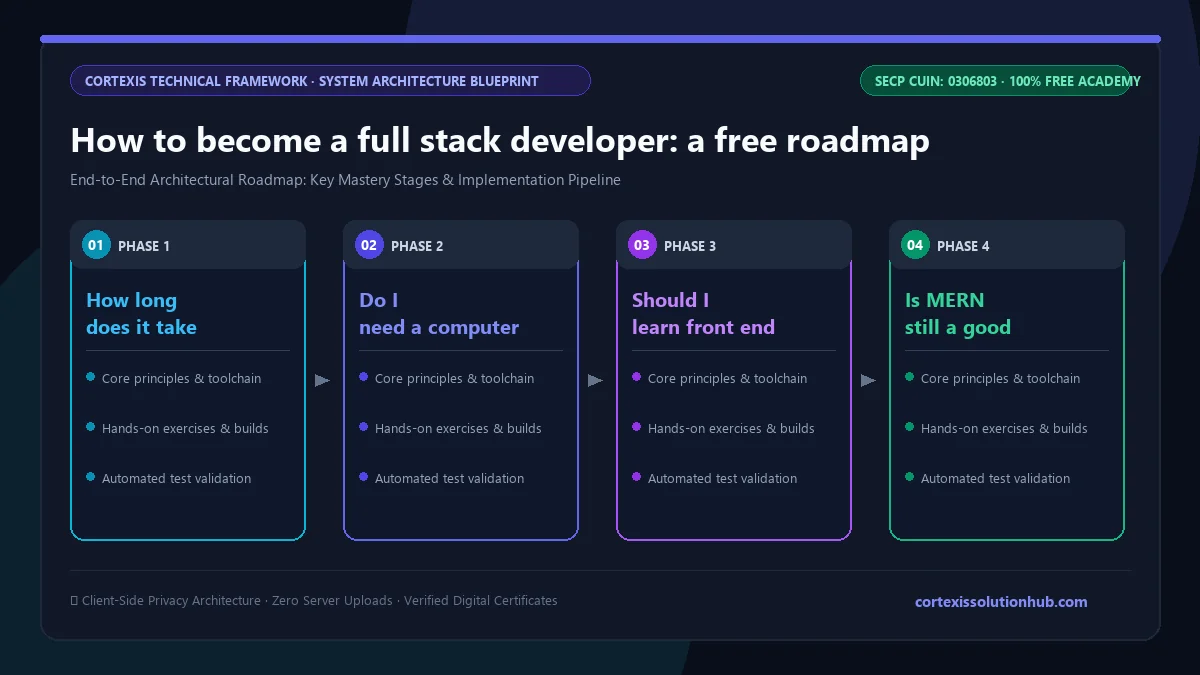
The order matters more than the speed. Each stage depends on the one before it, and most people who stall skipped a stage rather than failed one.
| Stage | What you learn | You are ready to move on when |
|---|---|---|
| 1. How the web works | Requests and responses, HTML, CSS layout, URLs, DNS, HTTPS | You can explain what happens between typing a URL and seeing a page |
| 2. JavaScript | Scope, functions, arrays and objects, async code, closures | You can fetch data with async/await and handle the error case |
| 3. React | Components, props, state, effects, routing | You can build a small multi page app that loads data from an API |
| 4. Node and Express | Modules, REST APIs, validation, status codes | Your API returns the right status code for bad input, not just for good input |
| 5. Data, auth, deployment | Database design, hashed passwords, tokens, authorisation, shipping | A stranger can sign up on your live app and only see their own data |
| 6. Testing and operations | Debugging by layer, API and UI tests, performance, migrations | You can change code without being afraid of what it breaks |
Stages one to five cover what junior work needs. Stage six, plus security and correctness, separates a demo builder from someone a team trusts with production.
Start with the request/response cycle, not a framework. Open your browser's Network tab and reload a page. Every line there is a request your future code will send or answer.
Learn JavaScript as a language before React. The bugs that confuse React beginners are almost always JavaScript bugs: a stale value captured by a closure, an array mutated in place so the screen never updates, a promise nobody awaited. Learn values, scope, immutable updates and async/await first, and React becomes much easier.
Build the front end against a fake API, then a real one. Once components and state make sense, fetch data from a public API, show a loading state, an error state and an empty state. Most beginner apps only handle the happy path.
Write the server yourself. Build a small Express API with three or four routes. Validate every input, return 400 for bad requests, 404 for missing things and 401 or 403 for permission problems. Then point your React app at it.
Add a database and real users. For most business apps a relational database such as PostgreSQL is the honest default, because courses have chapters, users have orders, and that is a relational shape. Hash passwords, never store them plainly, and check on the server that a user is allowed to touch the record they asked for.
Deploy early, not at the end. Put a bare version online in the first weeks and redeploy as it grows. Environment variables, CORS and production builds behave differently from your laptop, and that is easier to learn on a small app.
Put everything on GitHub from day one. If Git is new to you, the free Git and GitHub course covers branches, commits and pull requests properly.
The Full-Stack Web Development course is written, not video, and is labelled beginner to advanced. Its own summary is to go from raw HTML to a deployed application with a React front end, an Express API and a real database behind it, built one layer at a time.
There are 12 chapters with 4 topics each, 48 topics in total, adding up to roughly 10 hours of reading. The course page suggests 8 weeks at a steady pace.
| Chapter | What it covers |
|---|---|
| 1. How the Web Works | The request/response cycle, semantic HTML, CSS layout, URLs, DNS and HTTPS |
| 2. JavaScript for Applications | Values, scope and functions, immutable updates to arrays and objects, promises and async/await, closures |
| 3. Building UIs with React | Components and props, state and events, effects and data fetching, routing and shared state |
| 4. Servers, APIs, and Node | The module system, REST APIs with Express, validation and status codes, structuring a server that grows |
| 5. Data, Auth, and Deployment | Modelling data, hashed passwords and tokens, shipping to production, authorisation |
| 6. Debugging and Automated Testing | Finding the layer a bug lives in, Vitest and Supertest, testing React the way users use it, Playwright end to end tests |
| 7. Performance, Scale, and Operations | Making the database do less work, front end performance, pipelines and migrations, scaling beyond one process |
| 8. Real-Time and Event-Driven Features | Polling vs SSE vs WebSockets, broadcasting across instances, optimistic UI, reconnects and offline writes |
| 9. Security Beyond the Login Form | XSS and Content Security Policy, cookies and CSRF, OAuth and single sign on, dependencies and secrets |
| 10. Correctness When Requests Collide | Transactions, lost updates and optimistic concurrency, idempotency keys, audit trails and the right to erasure |
| 11. Reliability, Telemetry, and Cost | Timeouts, retries and circuit breakers, tracing, service levels and alerts, load testing and capacity |
| 12. Evolving a System People Depend On | When to split a service, versioning an API, replacing a running system piece by piece, technical decisions a team can live with |
The first five chapters are the core roadmap above. Chapters six to twelve cover what most beginner courses leave out and what real teams ask about.
It suits students, career switchers and self taught developers who want one connected path instead of separate tutorials for each tool. The course starts at raw HTML, but it moves quickly, so if you have never written any code at all, a few weeks of basic programming first will make it far less frustrating.
If you already know you want to specialise, the Frontend Engineering course goes deeper on the browser side and the Node.js Backend course goes deeper on servers.
The reading is about 10 hours, but reading is not the work. Budget extra time for typing the examples and building your own app alongside them.
Each topic has a minimum reading time of 90 seconds before its quiz opens, and you need 70 percent on that quiz to unlock the next topic. Each chapter ends with a quiz that opens once you finish its topics, and you must pass every chapter quiz before the final exam unlocks.
The certificate comes from the final exam: 50 questions, 60 minutes, one timed attempt, and you pass with 50 out of 100 marks. If you do not pass, a retake opens 30 days later with the questions and options reshuffled. Pass, and you get a free certificate with a verification code and a QR code anyone can check. Be honest with yourself about its weight, though: a hiring manager will learn more from a live app and a clean repository than from any certificate, ours included. When you have both, our guide on applying for a software house internship in Pakistan covers the next step.
Ready to start? Open the free Full-Stack Web Development course, read the first topic on the request/response cycle today, and open your browser's Network tab while you do.
05 questions
It depends on your starting point and your hours. With an hour or two a day, many people can deploy a complete small app within a few months. Job ready takes longer: a second, harder project and the ability to explain your decisions.
No. A degree helps with some employers and with formal hiring filters, but for web work a live project, a readable GitHub history and the ability to talk through a bug you fixed carry a lot of weight. If you are already studying, keep the degree and build on the side.
Front end first, because you can see the result, and HTML, CSS and JavaScript are needed on both sides anyway. Move to the server once you can build a small React app that fetches data.
Yes. MongoDB, Express, React and Node remain common, and the ideas carry to any stack. Our course uses React, Express and Node, and explains when a relational database such as PostgreSQL is the better fit than a document database like MongoDB.
Yes. The lessons, quizzes, final exam and certificate are all free. You need an account to track your progress and sit the exam.