06Shipping It: Serving, Versioning, and Monitoring
07Debugging Models and Testing ML Code
08Time Series: Backtesting, Lags, and Regime Change
09Scaling It: Memory, Latency, and Cost
10Neural Networks, Embeddings, and Pretrained Models
11Proving It Helped: Experiments and Causal Impact
12Governance, Lineage, and a Portfolio of Models
Final exam
Certificate
48 topics · ~11h
Accredited Curriculum & Certification
Official Syllabus Snapshot
Direct Answer: Learn to build, evaluate, and distrust machine learning models properly — from linear regression to gradient boosting, with scikit-learn in your hands the whole way.
Tuition Fee
100% Free
Duration & Workload
~11 Hours
Curriculum Depth
12 Chapters · 48 Lessons
Credential Awarded
Verified Certificate
12Chapters
Course outline
The honest definition, the two families of problems, and the split that makes any of it trustworthy.
Learning From Data, Not Rules12 min
Supervised, Unsupervised, and Which You Have12 min
Train, Validation, Test — the Split That Makes It Real13 min
Baselines: The Score You Have to Beat12 min
The two workhorses you should always try first, and the overfitting problem they teach you to see.
Linear Regression From the Ground Up13 min
Logistic Regression and the Threshold You Choose13 min
Overfitting, Bias–Variance, and Regularisation14 min
Gradient Descent and the Solver Underneath13 min
The models that win on tabular data, and why combining weak learners beats tuning one strong one.
Decision Trees: Learning a Flowchart12 min
Random Forests and the Power of Bagging13 min
Gradient Boosting: Learning From Your Own Mistakes14 min
Stacking: Combining Models That Fail Differently13 min
Why accuracy lies, which metric matches your decision, and how to tune without fooling yourself.
The Confusion Matrix, Precision, Recall, and F113 min
ROC-AUC, PR Curves, and Choosing the Threshold14 min
Cross-Validation and Hyperparameter Search14 min
Error Bars: Is Model B Actually Better?14 min
The engineering that actually moves scores, learning without labels, and the failures no metric will show you.
Feature Engineering and the scikit-learn Pipeline14 min
Clustering: Finding Structure Without Labels13 min
Bias, Leakage, and the Limits of Models15 min
PCA: Fewer Dimensions, and What It Costs13 min
Getting a fitted pipeline out of the notebook, behind an API, and under watch — plus the skew that quietly ruins good models.
Persisting a Model Nobody Can Load Wrong13 min
A Prediction Service That Does Not Lie14 min
Monitoring, Drift, and Deciding to Retrain14 min
Packaging the Service: Pinned Images and the Threads Bug13 min
Error analysis that finds the real defect, explanations you can defend, and the tests that stop a pipeline breaking in silence.
Error Analysis: Read the Mistakes, Not the Metric14 min
Explanations You Can Defend14 min
Testing ML Code So It Fails Loudly14 min
When the Model Will Not Learn: A Triage13 min
What changes once rows arrive in an order, from the backtest that replaces cross-validation to the features you are actually allowed to compute at prediction time.
Walk-Forward Backtesting and the Gap You Must Leave13 min
Lag, Rolling, and Point-in-Time Correct Features14 min
Forecast Horizons: Recursive, Direct, and the Baseline That Wins13 min
Non-Stationarity: Recency Weighting and Rolling Retrains14 min
Making a working model survive real volume, from data that will not fit in RAM to the price of a thousand predictions.
Data That Will Not Fit: Dtypes, Sparse Matrices, and Chunks13 min
Where the Training Hours Actually Go13 min
Latency Budgets: Batching, Caching, and Compiled Models13 min
The Unit Economics of a Prediction13 min
Where a network genuinely beats a boosted tree, and how to borrow representations somebody else spent millions of dollars learning.
From Logistic Regression to a Multilayer Network13 min
Training a Network Without Wasting a Week13 min
Embeddings: Text and High-Cardinality Categories as Vectors13 min
Transfer Learning, Fine-Tuning, and When to Just Call an API13 min
Closing the gap between a metric that improved offline and a business that measurably got better because of it.
The Offline Metric Improved and Nothing Happened13 min
Running an A/B Test on a Model13 min
Prediction Is Not Intervention: Uplift and Treatment Effects13 min
Estimating Impact When You Cannot Randomise13 min
The obligations that arrive once decisions are automated, and what it takes to run many models for years instead of one for a quarter.
Model Cards, Intended Use, and the Sign-Off13 min
Reproducing a Decision From Eighteen Months Ago14 min
Regulated Decisions: Explanations, Appeals, and Recurring Audits14 min
The Portfolio: Registry, Retraining Pipelines, and Decommissioning13 min
Final exam & certificate
01
Topic checks
Each one opens the next topic
02
Chapter quizzes
Each one opens the next chapter
03
50-question final
50 of 100 marks to pass
04
Certificate
Issued instantly, verifiable
One attempt, 60 minutes. If you don't pass, you can retake once after 30 days.
The course guide
How to learn machine learning from scratch: a roadmap
16 October 2026 · 10 min read
To learn machine learning from scratch, get comfortable with Python and pandas first, then learn one small loop and repeat it until it is boring: split your data, score a dumb baseline, fit a simple model, measure it honestly, and read the mistakes it makes. Linear models, then trees and boosting, then evaluation, then everything else. Neural networks come late, not first. Most people who give up did it the other way round.
That is the short answer. The rest of this post is the order we would actually follow, what each stage is for, the traps that cost beginners months, and how our free AI & Machine Learning Essentials course maps onto it chapter by chapter.
What you need before you start
Less maths than you fear, more programming.
Before machine learning
How much you need
Why
Python
Comfortable: functions, loops, lists, dictionaries, reading an error
Every tool you will use is a Python library
pandas
Load a CSV, filter rows, group, join, handle missing values
Most real ML time is spent shaping data
SQL
Basic SELECT, WHERE, GROUP BY, JOIN
Data at work lives in databases, not CSV files
Statistics
Mean, spread, what a distribution looks like
You will be asked whether a score difference is real
Linear algebra and calculus
Intuition, not proofs
You can learn the pieces when a lesson needs them
If the first two rows are shaky, fix them before anything else. Our Python development course covers the language, and SQL for data analysis covers the querying. A week here saves a month later.
On hardware: classic machine learning on tabular data runs fine on an ordinary laptop. If yours is old, a free hosted notebook works too.
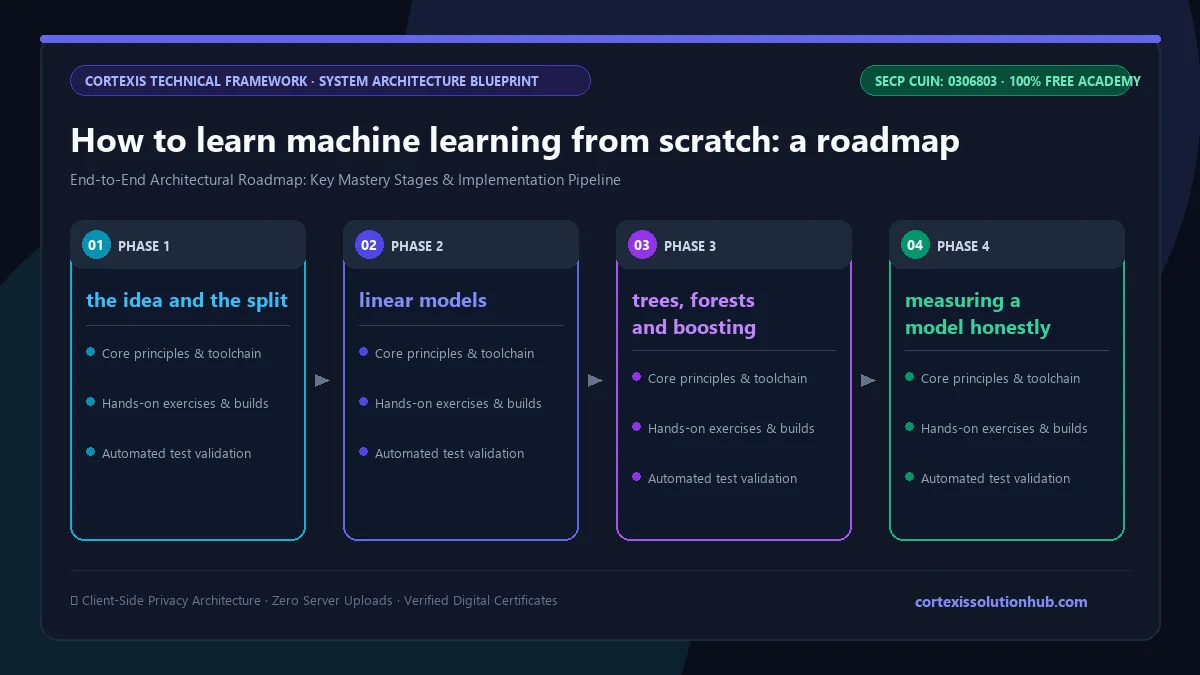
Figure 1: Complete step-by-step architectural workflow and technical execution stages for How to learn machine learning from scratch: a roadmap.
How to learn machine learning from scratch, step by step
Each stage below builds on the one before it. Skipping ahead is the most common reason people feel lost.
Stage 1: the idea and the split
Machine learning means writing a program that finds the rules from examples instead of you writing the rules. Learn the vocabulary once (feature, label, sample, training, inference), the difference between supervised and unsupervised problems, and above all the train, validation and test split. The test set is the only honest exam your model gets. If you look at it while building, you have spent it.
Then learn baselines. Before any real model, score something stupid: predict the most common class, or the average value. Every model you build afterwards has to beat that number, and you will be surprised how often a first attempt does not.
Stage 2: linear models
Linear regression for numbers, logistic regression for yes or no. They are fast, explainable, and often good enough. This is also where you meet overfitting, the bias and variance trade off, and regularisation, which are ideas you will use for the rest of your career.
Stage 3: trees, forests and boosting
On spreadsheet style data, tree ensembles are usually the strongest tool you have. Learn a single decision tree, then random forests, then gradient boosting. scikit-learn ships its own fast boosting models, and XGBoost, LightGBM and CatBoost are the specialist versions you will see in job posts.
Stage 4: measuring a model honestly
This is the stage most tutorials rush, and it is the one that separates people who can be trusted with a model from people who cannot. Accuracy lies whenever one class is rare. Learn the confusion matrix, precision, recall, F1, ROC and precision recall curves, cross validation, hyperparameter search, and how to put error bars on a score so you can say whether model B is actually better than model A.
Stage 5: features, pipelines and leakage
Feature engineering usually moves your score more than switching algorithms does. Wrap every preprocessing step in a scikit-learn pipeline so the same transformations run in training and in production. Learn data leakage here: information from the future or from the answer sneaking into your features, which produces a model that looks brilliant until it meets real data.
Stage 6 and beyond: shipping, debugging and the rest
Then learn to save a model, serve it behind an API, and watch it for drift, followed by error analysis, time series, scaling, neural networks, and proving a model helped a business at all. This is what turns a notebook into something an employer can use.
How long it takes to learn machine learning
It depends on your starting point and your hours, so treat this as a shape rather than a promise.
Your starting point
Realistic first goal
What it takes
No programming yet
Python and pandas first
Plan for a few months before ML itself
Comfortable with Python
Build and evaluate models on tabular data
Roughly two months at a steady part time pace
Already doing data analysis
Add ML to your existing work
Weeks, since the data skills transfer
Our course is listed at eight weeks, with around eleven hours of reading across 48 topics. Reading is not the slow part. Running the code, breaking it and fixing it is, and that is where the learning happens.
Mistakes that waste months
Starting with deep learning. On tabular data a boosted tree usually beats a network, trains in seconds, and teaches you more about evaluation. Our course gets to networks in chapter 10 on purpose.
Collecting courses instead of building. Three half finished courses teach less than one finished course plus one project you can explain. Pick one path and finish it.
Trusting accuracy. If 2 in every 100 transactions are fraud, a model that says "never fraud" is 98 percent accurate and completely useless. Choose the metric that matches the decision someone will make with the prediction.
Touching the test set early. Each peek makes it a less fair exam. Use validation data or cross validation for decisions and look at the test set once.
Leakage you do not notice. A feature that is only known after the event you are predicting will make your score look wonderful. If a result seems too good, assume leakage and go hunting.
What the free AI & Machine Learning Essentials course covers
The course uses scikit-learn throughout and is written as text with code you run yourself, not as videos. It is aimed at people who already write some Python and want to go from beginner to a solid intermediate level. Here is what each of its 12 chapters covers.
Chapter
What you learn
1. What Machine Learning Actually Is
Learning from data, supervised versus unsupervised, the train, validation and test split, baselines
2. Linear Models
Linear and logistic regression, choosing a threshold, overfitting and regularisation, gradient descent
3. Trees, Forests, and Boosting
Decision trees, random forests and bagging, gradient boosting, stacking
Feature engineering and pipelines, clustering, bias and leakage, PCA
6. Shipping It
Saving a model safely, a prediction service, monitoring and drift, packaging
7. Debugging Models and Testing ML Code
Error analysis, explanations you can defend, testing ML code, triage when a model will not learn
8. Time Series
Walk forward backtesting, lag and rolling features, forecast horizons, regime change
9. Scaling It
Data that does not fit in memory, training time, latency budgets, the cost of a prediction
10. Neural Networks, Embeddings, and Pretrained Models
Multilayer networks, training without wasting time, embeddings, transfer learning and when to call an API
11. Proving It Helped
Why offline gains do not always show up, A/B testing a model, uplift, impact without randomisation
12. Governance, Lineage, and a Portfolio of Models
Model cards, reproducing old decisions, regulated decisions, running many models over years
Chapters 1 to 5 are the core roadmap above. Chapters 6 to 12 cover the work after a model exists, which most free material leaves out.
How the course and certificate work
Every chapter has four topics. Each topic has its own short quiz, and you need 70 percent on it to unlock the next topic. Each topic also has a minimum reading time of 90 seconds before its quiz opens, so you cannot click straight through. Each chapter then closes with a chapter quiz that pulls the four topics together.
The certificate comes from the final exam: 50 questions, 60 minutes, one timed attempt, and you pass with 50 out of 100 marks. If you fail, a retake opens 30 days later with the questions and options reshuffled. Pass, and you get a free certificate with a verification code and a QR code that anyone can check. Be realistic about what that paper is worth; we wrote about it honestly in are free online certificates worth anything.
What to do this week
Pick one public dataset with a clear thing to predict. Split it, score a baseline, fit a logistic or linear regression, and write down both scores. Then start AI & Machine Learning Essentials at one topic a day. If you later want to build products on large language models instead, AI engineering is the natural next course, and our AI engineer roadmap lays out that path.
Start with chapter 1 of AI & Machine Learning Essentials: learning from data, the split that makes a score trustworthy, and the baseline every model has to beat. It is free, and you can finish the first topic today.
Questions, answered
05 questions
Yes. What you need is working Python, comfort with data in pandas, and patience with evaluation. A degree helps with some employers, but the skills are learnable on your own.
Less than you fear to start. Basic statistics and an intuition for what a slope and an average mean will carry you through the first several stages. Pick up the linear algebra and calculus when a lesson needs them.
Machine learning first. Linear models, trees, boosting and honest evaluation are the foundation deep learning sits on, and on spreadsheet style business data they often perform better anyway. Neural networks make much more sense once you can already measure a model properly.
Yes. The lessons, quizzes, final exam and certificate are all free. You need an account to track progress and sit the exam.
If you already write Python, around two months of steady part time study gets you building and evaluating models on tabular data. If you are starting without programming, add a few months for Python and pandas first.