Direct Answer: Design large-scale systems with confidence: estimation, APIs, databases and caching, load balancing, queues, replication and sharding, consistency, resilience and observability, plus worked designs and interview practice.
Tuition Fee
100% Free
Duration & Workload
~10 Hours
Curriculum Depth
12 Chapters · 48 Lessons
Credential Awarded
Verified Certificate
12Chapters
Course outline
Understand what system design questions really ask, identify the non-functional requirements that shape architecture, estimate capacity with quick arithmetic, and learn the latency and throughput numbers every engineer should know.
What System Design Really Asks13 min
Non-Functional Requirements That Matter13 min
Back-of-the-Envelope Estimation13 min
Latency, Throughput and the Numbers to Know12 min
Design clean APIs that clients enjoy using, choose between REST, GraphQL and gRPC for the job, decide when communication should be synchronous or asynchronous, and handle versioning, pagination and idempotency well.
Designing Clean APIs13 min
REST, GraphQL and gRPC14 min
Synchronous Versus Asynchronous Communication13 min
Versioning, Pagination and Idempotency12 min
Know when relational databases are the right default, understand the main NoSQL families and their trade-offs, make queries fast with the right indexes, and choose a data store based on access patterns rather than fashion.
Relational Databases and When to Use Them13 min
NoSQL Families and Their Trade-offs14 min
Indexing and Query Performance13 min
Choosing a Data Store for the Job12 min
Decide why and where to cache, apply cache-aside, write-through and other strategies with sound invalidation, deliver static content through CDNs, and avoid stampedes, stale data and other classic cache pitfalls.
Why and Where to Cache13 min
Cache Strategies and Invalidation14 min
Content Delivery Networks13 min
Cache Pitfalls: Stampedes and Stale Data13 min
Compare vertical and horizontal scaling, distribute traffic with load balancers and their algorithms, design stateless services that scale freely, and plan capacity with autoscaling and headroom.
Vertical and Horizontal Scaling12 min
Load Balancers and Algorithms14 min
Stateless Services and Sessions13 min
Autoscaling and Capacity Planning13 min
Decouple systems with message queues and brokers, broadcast events with publish-subscribe and event streaming, understand delivery guarantees and build idempotent consumers, and run background jobs and schedules reliably.
Message Queues and Brokers13 min
Publish-Subscribe and Event Streaming13 min
Delivery Guarantees and Idempotent Consumers14 min
Background Jobs and Scheduling12 min
Scale reads with replication and read replicas while handling lag, split data with partitioning and sharding when a single node is not enough, choose shard keys that spread load evenly, and deal with hot partitions and rebalancing.
Replication and Read Replicas13 min
Partitioning and Sharding13 min
Choosing a Shard Key13 min
Handling Hot Partitions and Rebalancing13 min
Understand what CAP and PACELC really say about distributed trade-offs, choose consistency models that match business needs, coordinate work across services with sagas instead of distributed transactions, and see how consensus and leader election keep systems coordinated.
The CAP and PACELC Theorems13 min
Consistency Models in Practice13 min
Transactions Across Services and Sagas14 min
Consensus and Leader Election12 min
Design systems that expect failure, protect them with timeouts, retries and circuit breakers, control load with rate limiting and backpressure, and make operations safe to repeat with idempotency.
Designing for Failure13 min
Timeouts, Retries and Circuit Breakers14 min
Rate Limiting and Backpressure13 min
Idempotency and Exactly-Once in Practice13 min
See inside a running system with metrics, logs and traces, set service level objectives and use error budgets to balance speed and reliability, deploy changes safely with rollbacks ready, and weigh cost against performance deliberately.
Metrics, Logs and Traces13 min
Service Level Objectives and Error Budgets13 min
Deployment Strategies and Rollbacks13 min
Cost and Performance Trade-offs13 min
Apply every building block to complete designs: a URL shortener, a social news feed, a real-time chat system and a ride-hailing backend, each worked from requirements through estimation to architecture and trade-offs.
Designing a URL Shortener14 min
Designing a News Feed14 min
Designing a Chat System14 min
Designing a Ride-Hailing Backend13 min
Follow a repeatable framework for system design interviews, communicate trade-offs so interviewers see your judgement, avoid the mistakes that sink otherwise strong candidates, and build a study plan that turns knowledge into a career.
A Framework for System Design Interviews13 min
Communicating Trade-offs Clearly13 min
Common Mistakes and How to Avoid Them13 min
A Study Plan and Career Path12 min
Final exam & certificate
01
Topic checks
Each one opens the next topic
02
Chapter quizzes
Each one opens the next chapter
03
50-question final
50 of 100 marks to pass
04
Certificate
Issued instantly, verifiable
One attempt, 60 minutes. If you don't pass, you can retake once after 30 days.
The course guide
How to learn system design: a roadmap from scratch
16 October 2026 · 10 min read
The way to learn system design is to learn a small set of building blocks in order, then practise putting them together under time pressure. Start with requirements and rough capacity estimates, then APIs and data storage, then caching, load balancing and queues, then how databases scale, then consistency and failure handling. After that, work through full designs such as a URL shortener or a chat system, and redo each one from memory. Reading alone does not build the skill; explaining designs out loud and defending them does.
This guide lays out that order as a roadmap, explains what "ready to move on" looks like at each stage, lists the mistakes that waste the most time, and walks through our free System Design course chapter by chapter so you can judge whether it fits you before you start.
What system design actually is
Writing code that works for one user is programming. Designing something that keeps working for a very large number of users, survives a server dying in the middle of the night, and can still be changed by a team two years later is system design.
The course opens with an example that anyone who has ordered food in Pakistan will recognise. A developer builds an ordering app for a few restaurants in Karachi on one server and one database. It works. Then a delivery partnership brings in a flood of new users, orders spike at iftar time, the database locks up, and the app goes down at the worst possible moment. The code was fine. The system around it was never designed for that load.
System design is the habit of asking, before you build, how many users, what happens when this part fails, and what you will give up to keep the important things fast and reliable.
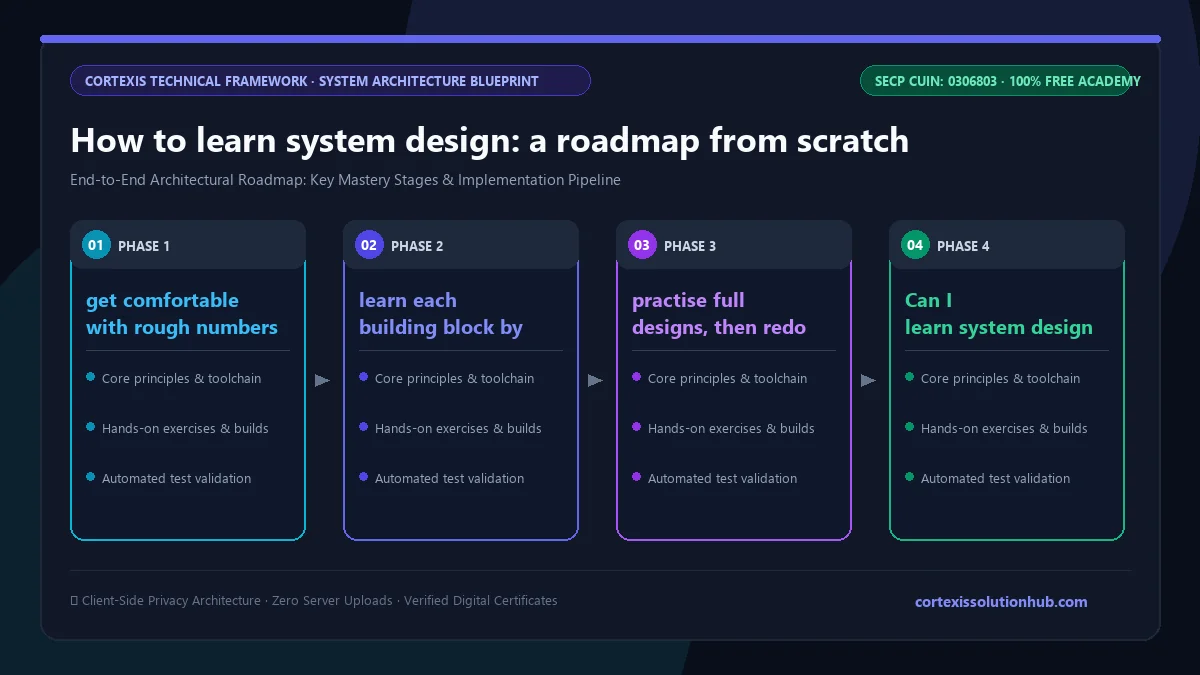
Figure 1: Complete step-by-step architectural workflow and technical execution stages for How to learn system design: a roadmap from scratch.
How to learn system design: the roadmap
Stage
What you learn
You are ready to move on when
1. Reasoning about scale
Functional and non-functional requirements, back of the envelope estimation, latency numbers
You can turn "a food app for a city" into rough requests per second and storage per year
2. Interfaces and storage
API design, REST, GraphQL and gRPC, relational versus NoSQL, indexes
You can justify a data store from access patterns, not habit
You can explain what happens to a request at each layer and where it gets cached
4. Decoupling
Message queues, pub/sub, delivery guarantees, background jobs
You know why "at least once" delivery means your consumers must be idempotent
5. Scaling data
Replication, partitioning, shard keys, hot partitions
You can pick a shard key and name the query it makes expensive
6. Correctness under failure
CAP and PACELC, consistency models, sagas, timeouts, retries, circuit breakers, rate limiting
You can say where your design accepts stale data and where it must not
7. Running it
Metrics, logs and traces, SLOs and error budgets, deployments, cost
You can say how you would know your system is unhealthy before users tell you
8. Putting it together
Full designs and a repeatable interview method
You can design a familiar system end to end in 45 minutes without notes
Stages 1 to 4 are the foundation. Stages 5 and 6 are where senior interviews separate people, and stage 7 is what makes you useful at work.
Step 1: get comfortable with rough numbers
Before any architecture, learn to estimate. How many requests per second at peak? How much storage does a year of orders need? The answers only have to be right within a factor of a few, and they decide whether you need one database or twenty.
Step 2: learn each building block by the problem it solves
Do not memorise "Redis, Kafka, Cassandra" as a list of names. Learn that a cache exists because the database is slow for repeated reads, that a queue exists because the user should not wait for an email to send, and that sharding exists because one machine can no longer hold the writes. Then name what each one costs: a cache brings stale data, replicas bring replication lag, sharding makes cross-shard queries painful.
Step 3: practise full designs, then redo them from memory
Work through a complete design, close your notes, and draw it again the next day. Then change one requirement, such as "it must work across two regions", and see what breaks.
Common mistakes that slow people down
Jumping to the diagram. The most common failure is drawing boxes before agreeing what the system must do and at what scale. Requirements first, always.
Collecting technology names. Saying "I would use Kafka" without stating the requirement that needs it is assertion, not design.
Designing for a scale nobody asked for. Sharding the database of an internal tool is a cost with no benefit. A single well indexed relational database is the right answer more often than people admit.
Ignoring failure. Every network call can hang. A design without timeouts, retries with backoff and some idea of what happens when a dependency is down is incomplete.
Only reading. You can read every chapter twice and still freeze on "design a ride-hailing backend". Timed practice cannot be skipped.
What the free System Design course covers
The System Design course is written, not video, and is labelled intermediate to advanced. It has 12 chapters with 4 topics each, 48 topics in total, adding up to roughly 10 and a half hours of reading. The course page suggests 7 weeks.
Chapter
What it covers
1. Foundations of System Design
What design questions really ask, non-functional requirements, back of the envelope estimation, latency and throughput numbers
2. APIs and Communication
Designing clean APIs, REST, GraphQL and gRPC, synchronous versus asynchronous calls, versioning, pagination and idempotency
3. Data Storage Choices
Relational databases, NoSQL families and their trade-offs, indexing and query performance, choosing a store for the job
4. Caching and Content Delivery
Why and where to cache, cache strategies and invalidation, CDNs, stampedes and stale data
5. Load Balancing and Scaling
Vertical and horizontal scaling, load balancer algorithms, stateless services and sessions, autoscaling and capacity planning
6. Asynchronous Processing
Message queues, publish-subscribe and event streaming, delivery guarantees and idempotent consumers, background jobs and scheduling
7. Scaling the Database
Replication and read replicas, partitioning and sharding, choosing a shard key, hot partitions and rebalancing
8. Consistency and Coordination
CAP and PACELC, consistency models in practice, transactions across services and sagas, consensus and leader election
9. Resilience and Reliability
Designing for failure, timeouts, retries and circuit breakers, rate limiting and backpressure, idempotency and exactly once in practice
10. Observability and Operations
Metrics, logs and traces, SLOs and error budgets, deployment strategies and rollbacks, cost and performance trade-offs
11. Worked Designs
A URL shortener, a news feed, a chat system and a ride-hailing backend, each end to end
12. Interviews and Practice
A framework for design interviews, communicating trade-offs, common mistakes, a study plan and career path
The examples are local where it helps, such as a user in Peshawar waiting on an image served from Frankfurt. The interview chapter gives you a five phase framework (requirements, estimation, high level design, deep dives, wrap-up) with rough timings for a 45 minute session, and a list of practice prompts such as a rate limiter, a payment system and a booking system that has to prevent double bookings.
The last topic also points you to two books worth reading alongside it, "Designing Data-Intensive Applications" and "Site Reliability Engineering", and to public postmortems, which show how real systems fail better than any theory chapter can.
Who this course is for, and how long it takes
It suits you if you already build backends and want to understand why your senior colleagues make the choices they do, if you are preparing for interviews at larger companies or remote roles where design rounds are standard, or if you are a final year CS student who wants to go past CRUD apps.
It is not a first course. You should be comfortable building a simple web backend with a database. If you are not there yet, start with Node.js Backend, and read our guide on how to learn data structures and algorithms, because design interviews often sit next to coding rounds. If you want to see how these systems get deployed and run, Cloud & DevOps and our DevOps roadmap are the natural companions.
On time: 10 and a half hours of reading is not the learning. The final chapter's study plan asks for at least one full timed design per week from the third week on. With an hour a day of real practice, 7 weeks is realistic.
How the quizzes and free certificate work
Each topic has a minimum reading time of 90 seconds before its quiz opens, and you need 70 percent on that quiz to unlock the next topic. Each chapter ends with a chapter quiz, and you need to pass it to open the next chapter.
The certificate comes from the final exam, which opens once every topic is complete and every chapter quiz is passed: 50 questions, 60 minutes, one timed attempt, and you pass with 50 out of 100 marks. If you do not pass, a retake opens 30 days later with the same questions in a new order and their options reshuffled. Pass, and you get a free certificate with a verification code and a QR code anyone can check. It will not replace a strong design interview, but it is honest proof that you did the work.
Ready to start? Open the free System Design course, read the first topic today, and estimate the peak requests per second of an app you use every day.
Questions, answered
04 questions
Yes, up to a point. You can learn every building block and practise full designs on your own. What experience adds is the instinct for what actually breaks, so read public postmortems, write short design documents for your own projects, and ask experienced engineers to review them.
DSA first if you are early in your career, because junior interviews lean on coding problems and design builds on solid programming. Once you can build and deploy a backend, start system design alongside it.
The core concepts take a few focused weeks. Being able to design a familiar system confidently in 45 minutes usually takes a couple of months of regular timed practice.
Yes. The lessons, quizzes, final exam and certificate are all free. You need an account to track your progress and sit the exam.