
10 min read
Direct Answer: How to learn data structures and algorithms from scratch, in the right order, with patterns to practise, mistakes to avoid and a free certificate course.
- How to learn data structures and algorithms from scratch, in the right order, with patterns to practise, mistakes to avoid and a free certificate course.
- Authored by Umair with actionable, zero-fluff implementation guidance.
- Verified for immediate practical application, production workflows, and professional skill enhancement.
The best way to learn data structures and algorithms is in a fixed order: Big-O first, then arrays and hash maps, then the pointer and window patterns, then stacks, linked lists, recursion and trees, and only then graphs and dynamic programming. Build each structure by hand once, work out what every operation costs, and solve a handful of problems with it before you move on. Most people who give up on DSA did not lack talent. They started with dynamic programming because a video said it was important, or they memorised hundreds of solutions without ever learning the handful of patterns underneath them.
This guide gives you that order as a roadmap, the habits that make it stick, the mistakes that waste months, and an exact chapter by chapter look at our free Data Structures & Algorithms course, so you can decide if it fits before you start.
Why DSA feels hard at first
A data structure is a way of arranging data so that some operations are cheap. An algorithm is a sequence of steps that uses those operations. What makes DSA feel hard is that courses often present thirty structures as a flat list, with no sense of which ones you will use every week and which once a year.
In practice a small core does most of the work. A hash map turns "have I seen this before?" from a nested loop into a single lookup. Two pointers and a sliding window solve a surprising share of array and string problems in one pass. Breadth-first search finds shortest paths in unweighted graphs.
If you are a BSCS or BSSE student in Pakistan, DSA is probably already a semester course, often taught in C++. The ideas transfer between languages. If you are still deciding which language to use for everything else, we covered that in which programming language you should learn first.
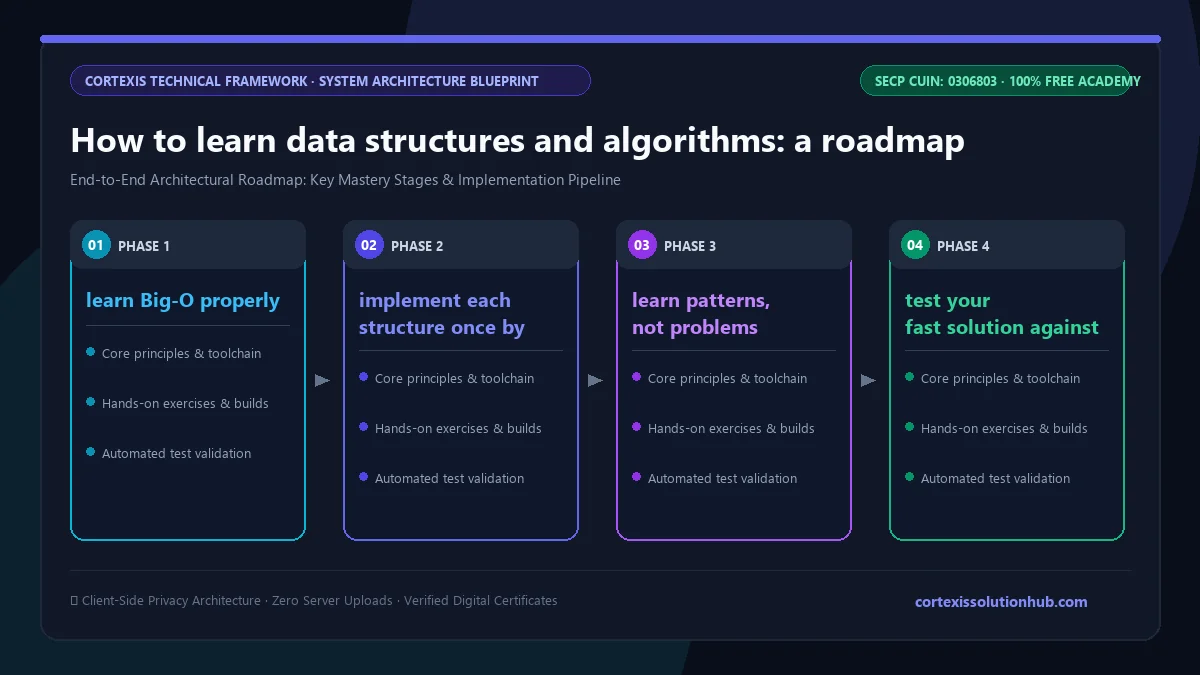
How to learn data structures and algorithms: the roadmap
Here is the order that works, and what "ready to move on" looks like at each stage.
| Stage | What you learn | You are ready to move on when |
|---|---|---|
| 1. Cost | Big-O, arrays, strings, hash maps and sets | You can say the complexity of your own code without guessing |
| 2. Linear patterns | Two pointers, sliding window, sorting, binary search, prefix sums | You solve array problems in one pass instead of nested loops |
| 3. Restricted structures | Stacks, queues, deques, linked lists | You can reverse a linked list without losing the rest of it |
| 4. Recursion and trees | The call stack, traversals, binary search trees, tries | You can write a tree traversal both recursively and with a stack |
| 5. Graphs and DP | DFS, BFS, dynamic programming, greedy | You can spot overlapping subproblems and turn recursion into a table |
| 6. Weighted graphs | Heaps, Dijkstra, topological sort, union-find | You know which shortest path algorithm fits which kind of edge weight |
Stages 1 to 5 cover most of what typical coding interviews ask. Stage 6 shows up in harder interviews and real systems work.
Step 1: learn Big-O properly
Before any structure, learn to count work. Sequential loops add, nested loops multiply, and an input that halves each step gives you a logarithm. That one idea explains binary search, balanced trees and merge sort. Spend real time here.
Step 2: implement each structure once by hand
Write a linked list, a stack, a binary search tree and a heap yourself at least once. Building a heap by hand is how you learn why the children of index i sit at 2i + 1 and 2i + 2.
Step 3: learn patterns, not problems
Group practice problems by technique. Do five sliding window problems in a row, then five BFS problems. When you meet a new problem, the question you train yourself to ask is "which pattern is this?", not "have I seen this exact question?".
Step 4: test your fast solution against a slow one
For every clever solution, write the obvious brute force version too, run both on many random inputs and compare. When they disagree, you have found a bug with the exact input that triggers it.
Common mistakes that slow people down
- Starting with dynamic programming. DP is recursion plus a cache. If recursion still feels shaky, DP will feel like magic, and magic does not stick.
- Memorising solutions. You will forget them. The patterns are what carry over to problems you have never seen.
- Skipping complexity analysis. A solution that passes small test cases and times out on large ones is a wrong solution.
- Using a greedy approach without checking it. Greedy choices often look right and fail on one awkward input. The classic is coin change with coins of 1, 3 and 4 for a total of 6: greedy picks 4, 1, 1 while the best answer is 3, 3.
What the free Data Structures & Algorithms course covers
The Data Structures & Algorithms course is written, not video, and is labelled beginner to advanced. You implement every structure by hand in JavaScript and analyse the cost of each operation as you go. If you have never written JavaScript, the syntax in the examples is simple, and the JavaScript chapter of our Full-Stack Web Development course covers the language itself.
There are 12 chapters with 4 topics each, 48 topics in total, adding up to roughly 11 hours of reading time. The course page suggests 8 weeks at a steady pace.
| Chapter | What it covers |
|---|---|
| 1. Complexity and Core Containers | Big-O, arrays and strings, hash maps and sets, references, copies and aliasing |
| 2. Pointer and Window Patterns | Two pointers, sliding window, sorting and binary search, prefix sums and range queries |
| 3. Stacks, Queues, and Linked Lists | Stacks, queues and deques, linked lists and pointer discipline, doubly linked lists and sentinels |
| 4. Recursion and Trees | Recursion and the call stack, binary trees and traversals, binary search trees, tries |
| 5. Graphs and Dynamic Programming | Graph representation and DFS, BFS and shortest paths, dynamic programming, greedy algorithms and when they fail |
| 6. Heaps, Priority Queues, and Union-Find | Heaps, Dijkstra and topological sort, union-find and minimum spanning trees, Bellman-Ford and Floyd-Warshall |
| 7. Algorithms in Production | Testing against a brute force oracle, measuring instead of guessing, choosing structures under real constraints, complexity as an attack surface |
| 8. Balanced Trees and Indexed Structures | Rotations, skip lists, Fenwick and segment trees, B-trees and the cost of a disk read |
| 9. String Algorithms and Search Indexes | Rolling hashes and Rabin-Karp, KMP, Aho-Corasick, inverted indexes |
| 10. Data Layout and the Machine | Bit manipulation and bitsets, typed arrays and cache lines, garbage collection and object pools, writing code the JIT can keep optimising |
| 11. Streaming, Sketches, and Parallel Work | One pass algorithms, sketches with bounded error, external sorting and k-way merge, parallel work with worker threads |
| 12. Intractable Problems in Practice | Recognising NP-hard problems, branch and bound, approximation with a guaranteed ratio, local search and solvers |
Chapters 1 to 6 are the interview core and the part every developer benefits from. Chapter 7, on proving fast code correct and measuring it, is worth every developer's time. Chapters 8 to 12 go into territory that many engineers only meet on the job, and it is fine to come back to them later.
Who this course is for, and how long it takes
It suits you if you are a CS student who wants to understand the material rather than cram it for the exam, a self taught developer who can build apps but freezes on technical interview questions, or someone heading towards backend or systems work, where our System Design course is the natural next step. If your degree teaches DSA in C++, the ideas here map directly, and our guide on how to learn C++ for beginners covers that side.
It is not a first programming course. You should already be comfortable with variables, loops, functions and arrays in some language. If you are not there yet, spend a few weeks on basic programming first, for example with our Python Development course, then come back.
On time: about 11 hours of reading is not 11 hours of learning. Type each example, break it, and solve a few practice problems per topic on your own. With an hour a day, 8 weeks is realistic for the core six chapters, and longer if you work through all twelve properly.
How the quizzes and free certificate work
Each topic has a minimum reading time of 90 seconds before its quiz opens, and you need 70 percent on that quiz to unlock the next topic. Each chapter ends with a chapter quiz, and you need to pass it to open the next chapter.
The final exam opens once every topic is complete and every chapter quiz is passed: 50 questions, 60 minutes, one timed attempt, and you pass with 50 out of 100 marks. If you do not pass, a retake opens 30 days later with the same questions in a new order and their options reshuffled. Pass, and you get a free certificate with a verification code and a QR code anyone can check. A certificate will not get you a job by itself, but it is honest proof that you finished the work.
Ready to start? Open the free Data Structures & Algorithms course, read the Big-O topic today, and work out the complexity of the last piece of code you wrote.
Questions, answered
05 questions
Yes. DSA is one of the most self teachable parts of computer science, because every idea can be checked by running code. What you need is a sensible order, a routine of daily practice, and the habit of testing your solutions against a brute force version.
Any mainstream language works. Python and JavaScript keep the syntax out of your way, while C++ and Java are common in university courses and competitive programming. Pick the one you already know best, because the concepts are the same in all of them.
The interview core, from Big-O through graphs and dynamic programming, takes most people a few months of steady daily practice. Comfort with harder topics such as weighted graphs, segment trees and string algorithms comes later and keeps growing with practice.
You need comfort with basic algebra and logarithms, and the patience to reason step by step. You do not need advanced mathematics for the interview core.
Yes. The lessons, quizzes, final exam and certificate are all free. You need an account to track your progress and sit the exam.