
10 min read
Direct Answer: How to start freelancing in Pakistan with no experience. Pick one service, build a small portfolio, win your first clients and get paid the legal way.
- How to start freelancing in Pakistan with no experience. Pick one service, build a small portfolio, win your first clients and get paid the legal way.
- Authored by Abdullah with actionable, zero-fluff implementation guidance.
- Verified for immediate practical application, production workflows, and professional skill enhancement.
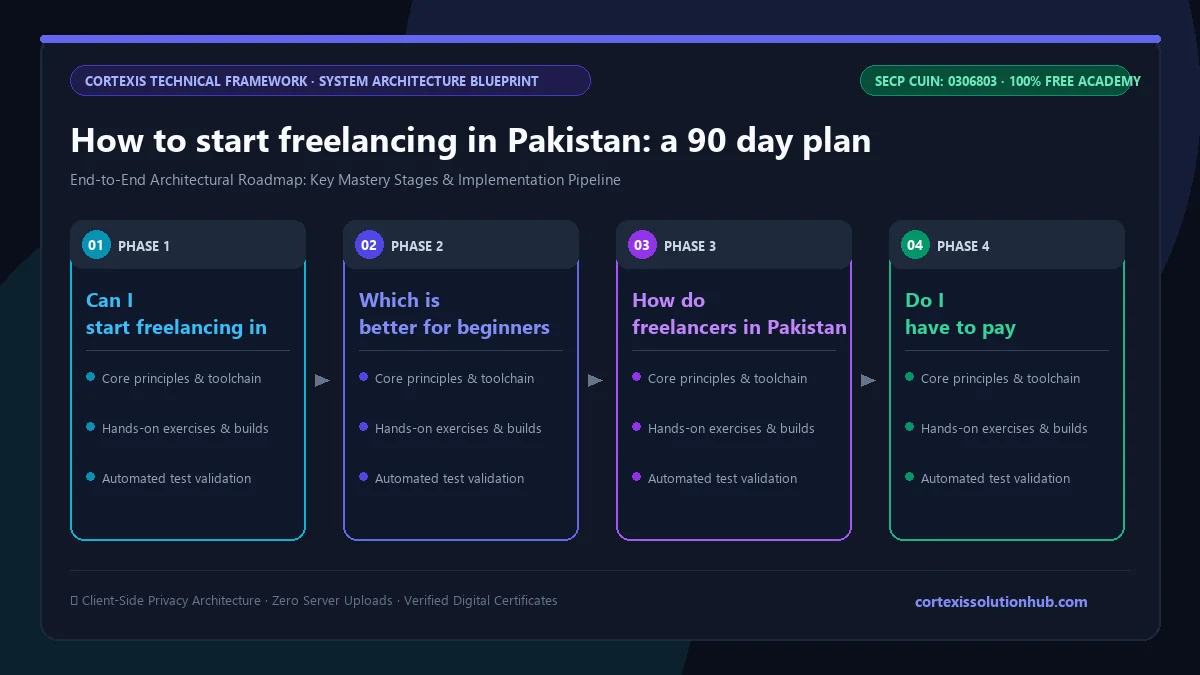
To start freelancing in Pakistan, pick one service you can already deliver well, build three or four portfolio pieces that show a result, set up one platform properly (Upwork, Fiverr or LinkedIn, depending on how your service is sold), and send a small number of careful, specific proposals every day for about ninety days. Get paid through a bank transfer or Payoneer in your own name, and register with FBR once money starts arriving. That is the whole plan. The hard part is doing it consistently while the first month feels quiet.
This guide walks through each step in order, the mistakes that waste the most time, and what our free Freelancing: Upwork, Fiverr & LinkedIn course covers if you want the full method with quizzes and a certificate.
How to start freelancing in Pakistan: begin with what clients buy
Most beginners describe themselves: "I am a graphic designer with 3 years of experience." Clients do not search for a person. A bakery owner wants a logo that makes a new shop look trustworthy before opening day. The skill is how you deliver; the outcome is what they pay for.
Behind almost every job post are three hopes: a result, low risk, and low effort on their side. A stranger on the internet is a risk, so everything you write should lower that risk. Cheap prices matter far less than beginners think. A client often pays more for the freelancer who feels safer to hire.
Step 1: choose one service you can deliver well
Choose one focused service with visible demand and stay with it for about ninety days. "Creative professional for all your digital needs" reads as no clear strength. "Video editor who turns long podcasts into daily short clips" tells the right client in one line that you are for them.
If you do not yet have a sellable skill, learn one first. Our free courses in graphic design, short form video editing and WordPress development are reasonable places to start.
Step 2: pick the platform that fits how your service is sold
The three main routes work differently, and choosing the wrong one for your service makes everything slower.
| Platform | How work reaches you | Suits | Watch out for |
|---|---|---|---|
| Upwork | You apply to job posts with proposals, paid for with Connects | Projects that need a conversation, hourly or fixed price work, development, writing, consulting | Connects cost money, so apply selectively |
| Fiverr | Buyers search and purchase your gig packages | Clearly defined deliverables, for example a logo with three concepts and two revisions | Your title, tags and images decide whether anyone sees you |
| People find your profile and posts, or you reach out directly | Higher value services and long term clients | Slow to build; trust grows over months, not days |
Start with one, get it working, then add a second.
Step 3: build a portfolio before your first client
You need three or four pieces that answer the question a client actually asks: has this person solved a problem like mine before?
- Label every piece with the problem and the result. "Logo for a Karachi bakery: three concepts, chosen in 4 days" beats "Logo design".
- Write short case studies. Problem, what you did, what changed. If you have no real numbers, describe the change plainly. Never invent figures to sound persuasive.
- Use practice work honestly. A redesign of a well known app is fine if you label it as a concept that was not commissioned. Calling it client work is not.
- Host it where clients look. Upload pieces to the platform portfolio itself, and if you use a Google Drive link, check it opens for anyone with the link before you send it.
Step 4: write proposals and gigs that answer the client
On Upwork, read the job post like a detective before spending any Connects. Look for what the client is worried about, how clear the scope is, and whether their history suggests they actually hire. Then write a short proposal that opens with their problem, mentions one similar past job, and ends with a simple question.
On Fiverr, research demand before you create the gig. Search as a buyer would and find a specific angle. Build three packages with clear deliverables, revisions and delivery times.
On LinkedIn, make your headline say what you do and for whom in five seconds, post about real problems you solve, and reach out to people one at a time with a message that is about them.
If writing to foreign clients makes you nervous, our guide on how to improve business English covers emails, calls and the phrases that sound natural.
Honest expectations for the first three months
Screenshots of huge first month earnings are real for a few people and misleading for almost everyone else. A more typical pattern looks like this:
| Month | What you mostly do | What usually happens |
|---|---|---|
| 1 | Build the portfolio, set up profiles, send proposals or publish gigs | Few replies, possibly no clients yet |
| 2 | Improve proposals and gigs based on what you learned | First small projects, often below your target rate |
| 3 | Deliver very well, collect reviews, raise rates slightly | Replies improve because reviews now lower the client's risk |
These are patterns, not promises. Keep your current income or studies going until freelance income is steady, and track proposals, replies and wins. No replies means fix the proposals; replies without projects means fix your conversations and pricing.
Mistakes that waste the most time
- Listing every skill you have. You look like a generalist competing on price.
- Copying one proposal for every job. Clients notice in the first line.
- Working for almost nothing for too long. A modest first price for a review makes sense; staying there does not.
- Doing free test work outside the platform. Offer a short sample or a small paid milestone, never final files for free.
- Taking payments off platform. It breaks platform rules and removes escrow protection.
- Using a friend's account or an "exchange agent". Both can freeze your money and leave income you cannot prove.
Getting paid in Pakistan the right way
PayPal does not support receiving payments for users in Pakistan, so do not plan around it, and be wary of anyone offering to receive PayPal for you. The usual routes are Upwork's direct transfer to a local bank, Payoneer (common among Fiverr sellers, and one account can receive from several platforms), and wire transfer, which usually carries a higher fixed fee and suits larger amounts. Always use an account in your own name, and confirm current options on each platform.
Ask your bank for the certificate it issues when foreign money arrives, often called a proceeds realisation or encashment certificate, and keep them. They prove your income came from abroad through official channels.
For tax, register on FBR's IRIS system to get an NTN linked to your CNIC, and file a return and wealth statement each year to appear on the Active Taxpayers List. Filers generally pay lower withholding tax than non filers, and income from IT and IT enabled services exported through banking channels has generally been taxed at lower rates, especially for freelancers registered with the Pakistan Software Export Board (PSEB). Rates change with each budget, so confirm the current rules with FBR or a tax practitioner before filing.
What the free course covers, chapter by chapter
The Freelancing: Upwork, Fiverr & LinkedIn course is a beginner course planned over 5 weeks, with 48 short topics adding up to roughly ten hours of reading. Each topic has its own quiz that unlocks the next one, and each chapter ends with a review quiz.
- How Freelancing Really Works. What clients buy, choosing a service, platforms compared, honest expectations.
- A Portfolio Before Your First Client. Pieces that prove results, case studies, honest practice work, hosting.
- An Upwork Profile That Gets Invited. Title and overview, skills and specialised profiles, rate, and getting approved.
- Proposals That Win on Upwork. Reading job posts, proposal structure, Connects and boosts, and learning from silence.
- Fiverr Gigs That Sell. Demand research, titles and tags, packages and extras, images, video and description.
- LinkedIn as a Client Magnet. A clear profile, content that attracts clients, outreach without spam, and turning chats into calls.
- Pricing With Confidence. Hourly, fixed and value pricing, your minimum rate, raising rates, and negotiating on scope.
- Communication and Client Management. Discovery calls, updates, scope creep, time zone boundaries.
- Contracts, Payments and Protection. Escrow and milestones, scams and red flags, disputes, and off platform rules.
- Getting Paid in Pakistan. Bank transfer and Payoneer, fees, FBR and PSEB, records and a budget.
- Reviews, Rankings and Repeat Work. Five star delivery, Job Success Score and seller levels, long term clients and referrals.
- From Freelancer to Agency. Productivity systems, productised services and retainers, subcontracting, and registering a business.
How the free certificate works
The certificate comes from passing the final exam, not from reaching the last page. The final is 50 questions in 60 minutes, and you need 50 out of 100 to pass. You get one timed attempt, and if it goes badly, one retake 30 days later with the questions reshuffled. Leaving the exam page submits it, so sit it when you have an uninterrupted hour.
Clients hire on portfolios and reviews, not certificates. We explain where one does help in are free online certificates worth anything.
Who this is for
It suits students who want income alongside a degree, graduates waiting for a first job, and people with a skill whose proposals keep going nowhere.
Ready to begin? Open the free Freelancing: Upwork, Fiverr & LinkedIn course, finish chapter 1 this week, and choose your one service before you touch a profile.
Questions, answered
05 questions
Yes, but not with no skill. You need one service you can deliver and a few honestly labelled practice pieces. Your first projects are about earning reviews.
It depends on your service. Fiverr suits clearly packaged deliverables. Upwork suits work that needs a conversation and a custom proposal.
Usually through Upwork's direct bank transfer, Payoneer, or wire transfer for larger amounts, always in your own name. PayPal does not support receiving payments in Pakistan.
Register with FBR and file an annual return. Filers usually pay less withholding tax, and IT export income received through banks has generally had lower rates. Check the current year's rules.
Some people land one in a week and some take longer than three months. Plan for about ninety days of steady effort and keep another income source meanwhile.