7 min read
Direct Answer: Two free coding games in your browser: guess what JavaScript and Python print, or race other typists on real code. No sign-up, nothing to install.
- Two free coding games in your browser: guess what JavaScript and Python print, or race other typists on real code. No sign-up, nothing to install.
- Authored by Umair with actionable, zero-fluff implementation guidance.
- Verified for immediate practical application, production workflows, and professional skill enhancement.
These are free coding games that run in your browser: Gotcha Rush, where you read a short JavaScript or Python snippet and type exactly what it prints, and TypeDash, a live typing race where you can type prose or real lines of code against other players. Both are free, both open in a tab, and neither asks you to make an account first.
Most "coding games" teach one idea with puzzles built for children, or turn programming into a drag and drop exercise. These two are different. They use the real languages, the real symbols and the real behaviour that trips up working developers, and they put you against other people with a clock running.
What makes a coding game worth your time
A good coding game should leave you better at the job, not just entertained. Before you spend an evening on one, check four things:
- It uses real code. Not blocks, not pseudo code. The exact syntax you will write at work or in an exam.
- It tells you why. A wrong answer you do not understand teaches nothing. The explanation is the lesson.
- Rounds are short. Five minutes between tasks is enough for a round or two, and short rounds are the ones you come back to.
- Someone is on the other side. A live opponent, a ranking or a daily streak is what turns practice into a habit.
Both games on this page were built around those four rules.
Gotcha Rush: guess what the code prints
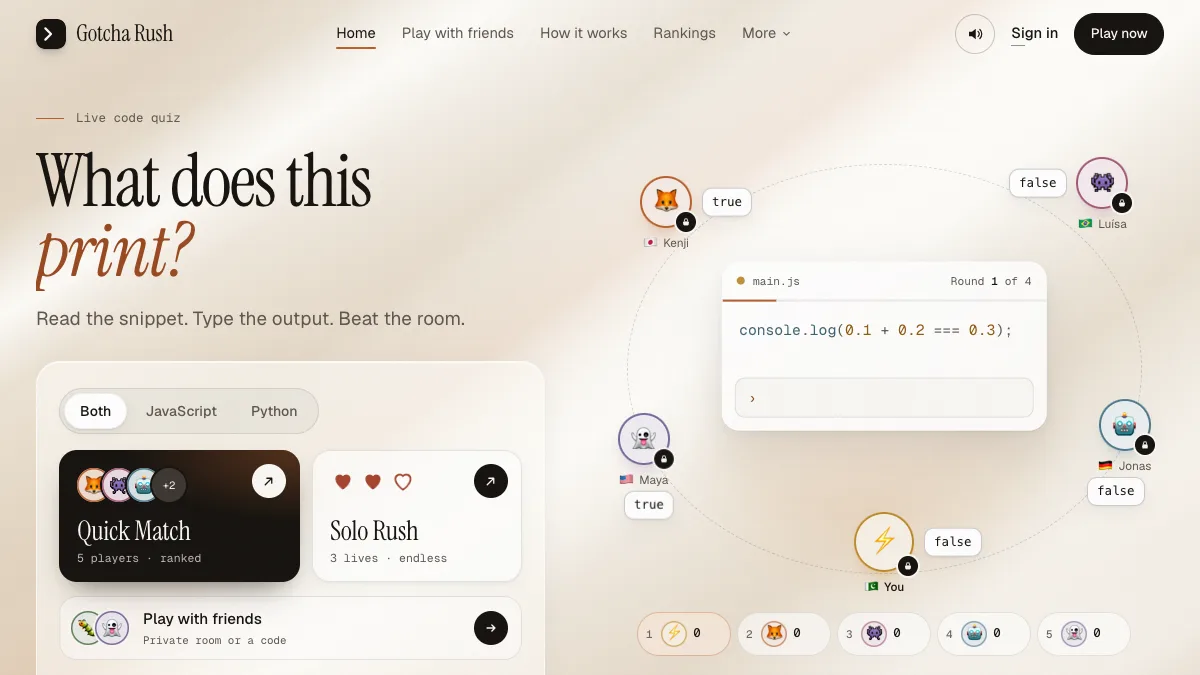
Gotcha Rush is a multiplayer "what does this print?" game. A room of up to five players sees the same tricky snippet. Everyone types the output they expect, line by line, before the clock runs out. Then the real output prints against your answer, followed by a short explanation of why the language behaved that way.
It is built on the gotchas every developer meets sooner or later: type coercion, floating point, closures in loops, the event loop, mutable default arguments, is versus ==. The puzzle bank has 83 snippets, 41 in JavaScript and 42 in Python, and every expected output was produced by actually running the code on Node.js and official Python Software Foundation runtime, not typed in by hand.
What keeps it a game rather than a quiz:
- Typed answers, not multiple choice. You get one box per line of output. Whitespace is forgiven, case is not.
- A lifeline turns a round into four options, for half the points.
- Speed matters. Locking in early earns a bonus, being first in the room earns another, and a combo multiplier grows with every round in a row you get right.
- Solo Rush gives you three lives, endless rounds and a timer that keeps shrinking. Your best run goes on the Rush board.
Want to try a few before you play? We wrote up 10 JavaScript output questions and 10 Python output questions from the same verified bank, with the reasoning for each.
TypeDash: a typing race, including real code
TypeDash is a real time multiplayer typing game. Up to five racers type the same passage, and every car moves live on the track. Empty seats fill with bots, so you never wait in an empty lobby. On top of the race sit combos, a nitro meter that charges with every flawless word, and three golden words per race worth a bonus if you type them without a mistake.
Rooms are matched by language and by mode:
| Mode | What you type |
|---|---|
| Prose | Sentences and short stories, in seven languages |
| Code | Real one liners in JavaScript, Python, SQL, Go, Rust, TypeScript, Bash and more |
| Numbers and symbols | Dates, prices and codes |
The code mode is what makes it a coding game. Brackets, arrows, semicolons and underscores are where programmers lose time, and ordinary typing tests never ask for them. Our guide to typing practice for programmers explains how to use it.
When nobody is online, practice mode starts in about two seconds. You can race a pacer set anywhere from 35 to 110 words per minute, the ghost of the world record on that passage, or your own best run. There is also a daily challenge: one passage a day, the same for everyone, and only your first finished run counts.
Which game should you play first?
| If you want to... | Play |
|---|---|
| Get better at reading code and predicting what it does | Gotcha Rush |
| Prepare for interview questions on JavaScript or Python | Gotcha Rush |
| Type faster, on prose or on code | TypeDash |
| Play something with friends tonight | Either, both have private rooms |
| Build a daily habit | Either, both keep a daily streak |
Free, with no sign-up and no install
Both games are free to play. There is no download and no sign-up form. The first time you connect, the game quietly creates an account for your browser, so your points, levels and streak are kept without asking for an email. Your progress lives with that browser.
Each game also has worldwide rankings, with a global board and one for your own country, plus a daily streak that adds 5 percent to every point you earn for each day in a row you play, up to 50 percent.
Coding games for beginners
You do not need to be an experienced developer to start. Gotcha Rush puzzles are graded from 1 to 4, and the easiest ones test things you meet in your first weeks of a language, such as what "1" + 1 gives in JavaScript or how floor division works in Python. Every reveal explains the answer, so a wrong guess still teaches you something.
If you are at the very start, a game works best next to a course. Our free Python development course and full stack web development course cover the language basics that these puzzles test.
Play with friends or a whole class
Both games let you open a private room and share an invite link. Private rooms are friendlies: they do not change the public rankings, but they keep your streak alive, record your head to head results and keep a running score for the room. That makes them a good fit for a group of friends, a study group or a class warm up. Our step by step guide shows how to start a typing race with friends.
Keep going: guides for both games
Questions, answered
05 questions
Yes. Both Gotcha Rush and TypeDash are free to play in the browser, with no download, no sign-up form and no paid tier.
They help most with the parts of coding that need repetition: reading code quickly, predicting what it will do, and typing symbols without hunting for them. They work best next to a structured course that teaches the concepts first.
JavaScript and Python. The bank has 83 puzzles, 41 in JavaScript and 42 in Python, and every answer was produced by running the code on Node 22 and CPython 3.12.
Yes. TypeDash works on phones and can be installed as an app from the browser. The keyboard opens as the race starts, so it is ready when the countdown hits go.
No. The game creates an account for your browser automatically on your first visit, so your points, level and streak are saved without an email address.