The purpose of testing, how to think about coverage, and writing a bug report worth acting on.
- Why Tests Exist11 min
- The Testing Pyramid12 min
- Test Cases and Bug Reports11 min
- Turning Requirements into Testable Criteria13 min
Learn to find bugs before users do.
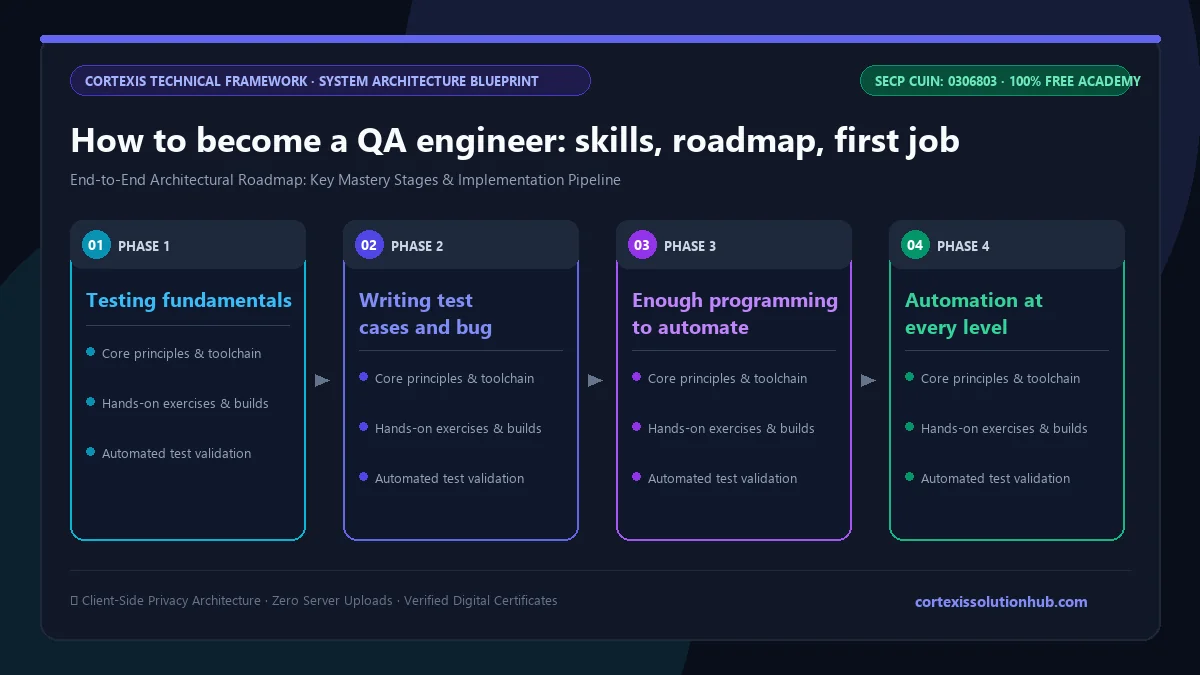
Read the guide: How to become a QA engineer: skills, roadmap, first job

Direct Answer: Learn to find bugs before users do, and to write automated tests that stay useful instead of becoming a maintenance burden.
The purpose of testing, how to think about coverage, and writing a bug report worth acting on.
Writing fast, focused tests — and the assertions and structure that make them readable.
Testing React components the way a user experiences them, not the way they are implemented.
API routes, database interaction, and the security cases worth an automated test.
Running tests automatically, keeping the suite trustworthy, and knowing when manual testing wins.
Measuring how the system behaves under real traffic, finding the bottleneck, and holding a front-end budget.
Accessibility you can automate, contracts between services, and proving your tests would actually catch a bug.
Asserting on behaviour that finishes long after the response returns: queued jobs, inbound webhooks, and work scheduled for next Tuesday.
Keeping a large suite fast, hermetic, and pleasant to work in once dozens of engineers depend on it every single day.
Probing a system the way someone hostile would, and turning every finding into a check that runs forever.
Proving a release is safe using real traffic, gradual exposure, and failures you cause on purpose.
Deciding what deserves testing at all, bringing an inherited system under cover, moving a suite without losing it, and owning the call on whether a release ships.
Topic checks
Each one opens the next topic
Chapter quizzes
Each one opens the next chapter
50-question final
50 of 100 marks to pass
Certificate
Issued instantly, verifiable
One attempt, 60 minutes. If you don't pass, you can retake once after 30 days.

To become a QA engineer, learn to think about risk first and tools second. Start by writing clear test cases and bug reports by hand, then learn enough programming to write unit tests, then move on to API tests, browser automation and running tests in CI. Build a small portfolio that shows real bugs you found and a test suite you wrote for a real app. You do not need a computer science degree, but you do need to be able to read code, because much QA work today involves at least some automation.
This guide gives you that path as a roadmap, explains what the job actually involves day to day, and shows what our free Software Testing & QA course covers chapter by chapter.
The job title covers a wide range, but the work is the same: find out where software breaks before users do, and make sure it stays fixed.
On a normal week, that means some mix of:
Testing cannot prove software works. It buys the team confidence to change things.
Many people start in manual testing and move into automation. Both are real QA work, and good automation engineers never stop doing exploratory testing.
| Manual and exploratory testing | QA automation | |
|---|---|---|
| Main skill | Curiosity, careful observation, clear writing | Programming, test design, debugging |
| Typical output | Test cases, bug reports, exploratory notes | Test code that runs on every change |
| Best at | Finding requirements nobody wrote down, usability problems | Catching regressions quickly and repeatedly |
| Tools | A browser, dev tools, a bug tracker | Jest, Playwright, Supertest, CI pipelines |
| Coding needed | Little to none | Yes, usually JavaScript, Python or Java |
Aim for automation but keep the manual skills.
Learn the difference between verification (did we build it right?) and validation (did we build the right thing?). Learn the testing pyramid: many fast unit tests, fewer integration tests, and a small number of end to end tests.
This sounds basic and it is where most beginners are weakest. A good bug report has a short, specific title, exact steps, what you expected, what actually happened, and the environment. "Login broken" wastes everyone's time. "Login with a valid email in uppercase returns 'user not found'" gets fixed.
JavaScript is a sensible choice because the same language covers unit tests, API tests and browser tests. Python and Java are also widely used for testing. Not sure yet? See which programming language to learn first.
Unit tests with a framework like Jest, API tests that send real HTTP requests, and browser tests with a tool like Playwright. Each catches a different kind of bug, and knowing which level a test belongs at is a large part of the skill.
The senior skill is knowing what not to test. Money, logins, permissions, data loss and complicated business rules deserve tests. A getter that returns a field does not. A slow, flaky suite that people ignore is worse than a smaller one they trust.
Plan for an hour or two a day. Pick one small web app, your own or an open source one, and use it as your practice target the whole way through.
| Week | Focus | You are ready to move on when you can |
|---|---|---|
| 1 | Purpose of testing, the pyramid, test cases, bug reports | Write ten test cases and three reproducible bug reports for your practice app |
| 2 | Unit testing with Jest, mocking, coverage | Write readable unit tests and explain what coverage does not tell you |
| 3 | UI and end to end testing | Test a form the way a user uses it, and write one stable browser test |
| 4 | API and back end testing, test data, security cases | Test that one user cannot read another user's data through the API |
| 5 | CI, flaky tests, exploratory testing | Run your suite automatically on every push and fix one flaky test |
| 6 | Performance, accessibility, risk based planning | Run a basic load test and rank what to test when time is short |
The Software Testing & QA course is a beginner to intermediate course planned for about 6 weeks. It has 12 chapters with 4 lessons each, every lesson an 11 to 13 minute read with a short quiz. The examples use JavaScript, Jest, Testing Library, Supertest, Playwright and k6.
Chapters 1 to 5 are the core a junior QA engineer needs. Chapters 6 onward are what separate someone who writes tests from someone a team trusts to own quality. If the back end chapters feel heavy, our Node.js backend course fills in how the APIs you are testing are built, and the Cybersecurity Fundamentals course goes deeper on the attacker mindset from chapter 10.
It suits fresh graduates looking for a way into a software house, manual testers who want to move into automation, and developers whose tests keep breaking or getting ignored. You should be comfortable reading basic JavaScript; you do not need to be an expert.
Each lesson unlocks its quiz after 90 seconds of reading, and you need 70 percent to pass it. The course ends with a final exam of 50 questions in 60 minutes, and you pass with 50 out of 100 marks. You get one timed attempt; if it goes badly, a single retake opens 30 days later. Pass, and you get a certificate with a verification code anyone can check.
Be honest about what it proves: that you passed our exam. For a QA role, a public repository with a real test suite, a CI badge and a few well written bug reports says much more. Our post on whether free online certificates are worth anything covers this in detail.
Build proof, not just knowledge. Take one open source web app and write a test plan for it, a set of unit and API tests, and two or three browser tests, all running in CI. Find real bugs while exploring, and write them up properly. Put it on GitHub with a short README explaining what you chose to test and why you skipped the rest.
Apply for junior QA, SQA and test automation roles, and for internships at software houses.
05 questions
Yes. What matters is clear thinking about risk, good bug reports and, for automation roles, working test code. A portfolio shows that better than any certificate.
With steady daily practice, the fundamentals and basic automation take a couple of months. Our course is planned for 6 weeks. Being job ready also depends on building a portfolio project, which usually takes a few more weeks.
For manual testing, very little. For QA automation, which many teams now expect at least some of, yes. You need to read and write code in one language well enough to build and debug tests.
It can be a solid entry point because it teaches you how real systems fail. Pure manual roles have less room to grow, so plan to learn automation.
Start with a bug tracker and your browser's developer tools, then a unit testing framework like Jest, an API testing tool, and one browser automation tool like Playwright. Learn Git alongside, since test code lives in the same repositories as the app. Start chapter one of the free [Software Testing & QA course](/learn/software-testing-qa) today, pick a practice app, and write your first bug report before the week is out. That is the first real step to becoming a QA engineer.