08The Service Container, Providers, and Architecture
09Advanced Eloquent and Big Tables
10External Services, Webhooks, and Payments
11Security Hardening and Tenant Isolation
12Evolving a Live Laravel Application
Final exam
Certificate
48 topics · ~10h
Accredited Curriculum & Certification
Official Syllabus Snapshot
Direct Answer: Build a real Laravel application end to end — routing, Blade, migrations, Eloquent relationships, validation, Breeze authentication, and a versioned REST API you would actually ship.
Tuition Fee
100% Free
Duration & Workload
~10 Hours
Curriculum Depth
12 Chapters · 48 Lessons
Credential Awarded
Verified Certificate
12Chapters
Course outline
The language features Laravel assumes, how Composer loads your classes, and exactly where a request goes.
PHP That Laravel Expects12 min
Composer, Autoloading, and the Project Layout12 min
MVC and the Request Lifecycle13 min
Traits, Interfaces, and Composition in PHP13 min
Mapping URLs to actions, keeping controllers thin, and rendering HTML that cannot be exploited.
Routing and Route Model Binding12 min
Controllers, Requests, and Responses12 min
Blade Templating, Layouts, and Components13 min
File Uploads and the Storage Disks13 min
Schema you can rebuild from code, models that are safe to mass assign, and relationships that do not melt the database.
Migrations and Schema Design13 min
Eloquent Models, Queries, and Mass Assignment13 min
Relationships and the N+1 Problem14 min
Transactions, Locking, and Concurrent Writes14 min
Guarding the boundary: form requests, Breeze auth with policies, and the middleware pipeline.
Validation and Form Requests13 min
Authentication with Breeze12 min
Middleware, CSRF, and Rate Limiting12 min
Sessions, Cookies, and Flash Data12 min
Resource controllers, JSON you control, token authentication with Sanctum, and tests that catch the dangerous bugs.
API Routes and Resource Controllers13 min
API Resources, Pagination, and Shaping JSON13 min
API Authentication, Tests, and Deployment14 min
CORS, Preflight, and the Browser Boundary13 min
Moving slow work off the request, decoupling with events, and running things on a clock without breaking a deploy.
Queues, Jobs, and Workers13 min
Events, Listeners, and Notifications12 min
The Scheduler and Long-Running Processes12 min
Batching and Chaining Jobs13 min
Making it fast under real data, proving it works before you ship, and finding out what actually broke when it does.
Caching and Query Performance at Scale13 min
Testing What Actually Breaks14 min
Logging, Debugging, and the Production Checklist13 min
Load Testing and Sizing PHP-FPM13 min
How Laravel builds and shares your objects, where to register your own, and how to stop a growing application collapsing into fat models and helper files.
Binding, Resolution, and Contextual Injection13 min
Service Providers, Deferred Loading, and Boot Order13 min
Actions, DTOs, and Models That Stop Growing13 min
Singletons, Shared State, and the Long-Lived Container13 min
The relationships, casts, and query shapes that only appear once the schema is real and the tables hold millions of rows.
Polymorphic Relations and hasManyThrough13 min
Custom Casts, Value Objects, and JSON Columns13 min
Subquery Selects, Aggregates, and Reporting Queries14 min
Ten Million Rows: Archiving, Partitions, and Read Replicas14 min
Calling systems you do not control, accepting calls you did not initiate, and moving money without ever charging anyone twice.
The HTTP Client: Timeouts, Retries, and Backoff13 min
Circuit Breakers and Degrading Without Dying13 min
Receiving Webhooks: Signatures, Replay, and Idempotency13 min
Subscriptions, Invoices, and Reconciling With Cashier13 min
The vulnerabilities that survive a correct login form, and the isolation that stops one customer ever seeing another customer's data.
Roles, Permissions, and Broken Object-Level Access13 min
Injection, Untrusted Files, and Security Headers13 min
Secrets, Key Rotation, and Encrypted Attributes13 min
Multi-Tenancy Without Cross-Tenant Leaks14 min
Changing a running application, its schema, and its framework version without downtime, and without stranding the team in a rewrite that never ships.
Expand and Contract: Schema Changes With No Downtime13 min
Feature Flags, Dark Launches, and Safe Rollback13 min
Upgrading Laravel and Auditing the Dependency Tree13 min
Strangling a Legacy Application Module by Module13 min
Final exam & certificate
01
Topic checks
Each one opens the next topic
02
Chapter quizzes
Each one opens the next chapter
03
50-question final
50 of 100 marks to pass
04
Certificate
Issued instantly, verifiable
One attempt, 60 minutes. If you don't pass, you can retake once after 30 days.
The course guide
How to learn Laravel step by step: a practical roadmap
16 October 2026 · 10 min read
If you want to know how to learn Laravel step by step, here is the short answer: get comfortable with modern PHP and Composer first, then learn routing, controllers and Blade, then migrations and Eloquent, then validation and authentication, and finish by building a small JSON API with tests. Build one project, a blog is perfect, and carry it through every step instead of starting a new tutorial each week. That order matters more than which video series you pick.
This guide gives you that roadmap in detail, the mistakes that cost beginners the most time, and an exact chapter by chapter look at our free Laravel Fundamentals course, so you can judge whether it fits you before you sign up.
Why Laravel is worth learning
Laravel is a PHP framework that gives PHP a structure. Routes live in one place, database changes live in migration files, and the framework handles things like sessions, CSRF protection, queues and password hashing so you do not write them badly yourself.
It is a good fit if you want to build complete web applications on your own, if you freelance and keep meeting PHP projects, or if a software house near you lists Laravel in its job posts. It is a weaker fit if you already know you want to work mainly in JavaScript on both ends, in which case our full stack web course is the more direct route.
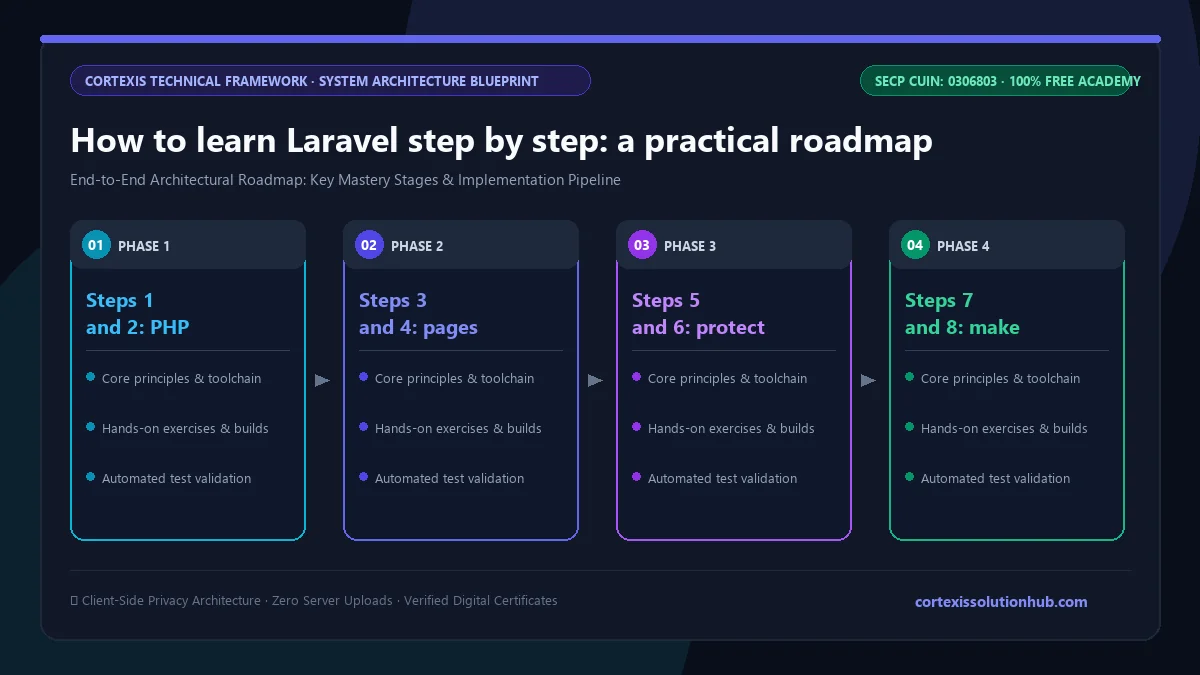
Figure 1: Complete step-by-step architectural workflow and technical execution stages for How to learn Laravel step by step: a practical roadmap.
How to learn Laravel step by step: the roadmap
Each step below builds on the one before. Do not move on until you can do the "you are ready when" part without looking anything up.
You can read a class with a promoted constructor and know what every line does
2. Composer and the lifecycle
Autoloading, project layout, how a request travels
You can explain where a request goes from public/index.php to your controller
3. Routing, controllers, Blade
Route model binding, thin controllers, layouts and components
You can build a page that lists and shows records with clean URLs
4. Database
Migrations, Eloquent, mass assignment, relationships
You can rebuild your whole schema from code and spot an N+1 query
5. The boundary
Form requests, Breeze authentication, policies, middleware
Users can register, log in, and only edit their own posts
6. REST API
Resource controllers, API resources, pagination, Sanctum
Your blog has a versioned JSON API protected by tokens
7. Background work
Queues, events, notifications, the scheduler
Slow work like sending email happens off the request
8. Production
Caching, testing, logging, a deploy checklist
You can find out what broke on a live server without guessing
Steps 1 and 2: PHP before the framework
The most common reason people find Laravel confusing is that they are really confused by PHP. Laravel code is full of type hints, namespaces, interfaces and closures. If those feel foreign, every error message will too. Spend a week on modern PHP and turn on declare(strict_types=1) from day one.
Then learn how Composer autoloading maps a namespace to a folder, and "class not found" errors stop being mysterious.
Steps 3 and 4: pages and data
Start your blog project here. Create routes, keep controllers short, and render with Blade layouts and components. Then design the schema in migrations, never by clicking around in a database tool, so anyone can rebuild it with one command.
Eloquent is where Laravel feels magical and where it quietly hurts you. Learn relationships properly, and learn to see the N+1 problem: a Blade loop that looks innocent but fires one extra query for every post on the page.
Steps 5 and 6: protect it, then open it up
Put validation in form requests, add Breeze for login, and write policies so a user can only update their own posts. Then expose the same data as a JSON API with API resources, which control exactly which columns leave your server, and protect it with Sanctum tokens.
Steps 7 and 8: make it behave like real software
Move slow jobs to a queue, learn what the scheduler is for, write feature tests for the dangerous paths, and work through a production checklist.
Common mistakes when learning Laravel
Tutorial hopping. Five half finished projects teach less than one finished one. Keep extending the same blog.
Calling env() outside config files. It works locally, then returns null on a server where the config has been cached. Read values through config() instead.
Ignoring mass assignment. Passing a whole request into create() without guarding the model lets users set fields you never meant them to touch.
Copying a unique rule without ignoring the current record. The classic result is a user who cannot save their own profile because their own email "is already taken".
Returning models straight from an API. Without an API resource, a column you forgot about can leak into every response.
Following old tutorials blindly. Laravel 11 slimmed down the project skeleton, and later versions kept that layout. Middleware is configured in bootstrap/app.php rather than app/Http/Kernel.php, and the base controller no longer includes the AuthorizesRequests trait. A guide written for Laravel 9 will send you looking for files that no longer exist. Starter kits moved on too: since Laravel 12 the official React, Vue and Livewire kits are the default for new projects, though Breeze still installs and teaches the same ideas.
What the free Laravel course covers
The Laravel Fundamentals course has 12 chapters with 4 lessons each, 48 lessons in total. You start from plain PHP and Composer and finish with a working blog plus its JSON API. Here is what each chapter teaches:
Chapter
What you learn
1. PHP, Composer, and the Laravel Lifecycle
The PHP Laravel expects, Composer autoloading and project layout, MVC and the request lifecycle, traits and interfaces
2. Routing, Controllers, and Blade
Routing and route model binding, controllers and responses, Blade layouts and components, file uploads and storage disks
3. Databases: Migrations and Eloquent
Migrations and schema design, Eloquent and mass assignment, relationships and the N+1 problem, transactions and locking
4. Validation, Authentication, and Middleware
Form requests, Breeze authentication, middleware, CSRF and rate limiting, sessions, cookies and flash data
5. Building a REST API
API routes and resource controllers, API resources and pagination, Sanctum authentication, tests and deployment, CORS
6. Queues, Events, and Scheduled Work
Queues and workers, events and notifications, the scheduler, batching and chaining jobs
7. Performance, Testing, and Production Debugging
Caching and query performance, testing what actually breaks, logging and a production checklist, load testing PHP-FPM
8. The Service Container, Providers, and Architecture
Binding and contextual injection, service providers, actions and DTOs, shared state in long lived processes
9. Advanced Eloquent and Big Tables
Polymorphic relations, custom casts and JSON columns, reporting queries, archiving and read replicas for very large tables
10. External Services, Webhooks, and Payments
The HTTP client with timeouts and retries, circuit breakers, receiving webhooks safely, subscriptions with Cashier
11. Security Hardening and Tenant Isolation
Roles and object level access, injection and untrusted files, secrets and key rotation, multi tenancy without leaks
12. Evolving a Live Laravel Application
Zero downtime schema changes, feature flags and rollback, upgrading Laravel, replacing a legacy app module by module
The first seven chapters are the core you need to build and ship an application. Chapters 8 to 12 are what you meet once that application has real users, real data and a team working on it.
Who it is for, and how long it takes
The course is labelled Beginner to Intermediate. It suits students who want a serious portfolio project, WordPress developers who want to build custom applications instead of stacking plugins (our WordPress development course covers that side), freelancers who keep getting PHP work, and developers joining a Laravel team.
If you have never written code at all, spend a few weeks on basic programming first. The course teaches the PHP that Laravel relies on, but it assumes you already know what a variable, a loop and a function are. If you are still deciding on a first language, read which programming language you should learn first in Pakistan.
On time: the lesson reading alone adds up to about ten hours, but reading is the small part. Typing out the examples, breaking them on purpose and building your own blog alongside is where the learning happens. With an hour a day, the 8 week estimate is realistic. You will also want basic Git, so that every step of your project is saved; our Git and GitHub course is short.
How the quizzes and free certificate work
Each topic has a minimum reading time of 90 seconds before its quiz opens, and you need 70 percent on that quiz to unlock the next topic. Chapter quizzes are practice with instant feedback.
The certificate comes from the final exam: 50 questions, 60 minutes, one timed attempt, and you pass with 50 out of 100 marks. If you do not pass, a retake opens 30 days later with the questions and options reshuffled. Pass, and you get a free certificate with a verification code and a QR code anyone can check.
Be honest with yourself about what it proves. A certificate shows you finished and understood the material. A deployed Laravel app with a clean GitHub history shows you can do the work, and that is what a client or employer will actually open. We wrote more about this in are free online certificates worth anything.
Start learning Laravel today
Pick your project, set up PHP and Composer, and work through the steps in order. When you want a structured path that takes you from your first route to a tested, deployed API, start the free Laravel Fundamentals course and build your blog alongside it, one chapter at a time.
Questions, answered
05 questions
Not comfortably. Laravel is PHP with strong conventions, so every confusing PHP feature shows up as a confusing Laravel error. Learn modern PHP first, or take a course like ours that starts with the PHP Laravel expects before touching the framework.
With an hour a day and some programming background, about two months to build and ship a small application with authentication and an API. Getting truly good at it takes longer and comes from real projects, not more tutorials.
Choose by what you want to build and where you want to work. Laravel gives you more built in, which helps a solo developer move fast. Node.js lets you use one language on the front end and back end. Look at the job posts and freelance projects you actually want, and our [Node.js backend course](/learn/nodejs-backend) is there if you choose that route.
Yes. The lessons, quizzes, final exam and certificate are all free. You need an account to track your progress and sit the exam.
A blog with users, posts and comments. It touches routing, Blade, migrations, relationships, validation, authentication and policies, and it extends naturally into a JSON API. That is the project the course builds, so you can follow along step by step.