Direct Answer: Learn modern Java from the ground up, then build production-ready REST APIs with Spring Boot: JPA and PostgreSQL, validation, Spring Security with JWT, testing with JUnit and Testcontainers, and Docker deployment.
Tuition Fee
100% Free
Duration & Workload
~10 Hours
Curriculum Depth
12 Chapters · 48 Lessons
Credential Awarded
Verified Certificate
12Chapters
Course outline
Understand why Java powers so many enterprise systems, install a JDK and an IDE, write, compile and run your first program, and work with Java's types, variables and operators.
Why Java Still Runs the Enterprise12 min
Installing the JDK and an IDE13 min
Your First Program: Classes, main and Compilation13 min
Variables, Types and Operators14 min
Make decisions with if statements and modern switch expressions, repeat work with loops, organise logic into methods, and handle text efficiently with String, StringBuilder and text blocks.
Conditions and Switch Expressions13 min
Loops and Iteration12 min
Methods, Parameters and Return Values13 min
Strings, StringBuilder and Text Blocks13 min
Model real things with classes, objects and constructors, protect data with encapsulation and records, reuse behaviour through inheritance and polymorphism, and design flexible code with interfaces, abstract classes and sealed types.
Classes, Objects and Constructors13 min
Encapsulation and Records13 min
Inheritance and Polymorphism14 min
Interfaces, Abstract Classes and Sealed Types13 min
Store and look up data with lists, sets and maps, write type-safe code with generics, pass behaviour around with lambdas and method references, and transform collections with the Stream API.
Lists, Sets and Maps13 min
Generics Without Fear12 min
Lambdas and Functional Interfaces13 min
The Stream API14 min
Handle errors with checked and unchecked exceptions, avoid null problems with Optional, build projects with Maven and Gradle, and prove your code works with JUnit 5 unit tests.
Exceptions and Error Handling13 min
Optional and Null Safety12 min
Maven and Gradle Builds13 min
Unit Testing With JUnit 514 min
Understand what Spring and Spring Boot do for you, generate and run a project with Spring Initializr, master dependency injection and beans, and configure applications with properties, YAML and profiles.
What Spring Boot Solves13 min
Creating a Project With Spring Initializr13 min
Dependency Injection and Beans14 min
Configuration, Profiles and application.yml13 min
Build REST controllers with request mappings, path variables and query parameters, validate input with DTOs and return clean error responses, design APIs that clients love, and test controllers with MockMvc.
Controllers and Request Mapping14 min
DTOs, Validation and Error Responses14 min
Designing a Clean REST API13 min
Testing Controllers With MockMvc12 min
Map Java classes to database tables with JPA entities, work with data through Spring Data repositories, model relationships without performance traps, query with paging and sorting, and manage transactions and schema changes with Flyway.
Entities and Repositories14 min
Relationships Between Entities14 min
Queries, Paging and Sorting13 min
Transactions and Flyway Migrations13 min
Structure Spring Boot applications into clear layers, map between entities and DTOs cleanly, log and monitor applications with SLF4J and Actuator, and improve performance with caching, scheduled jobs and asynchronous work.
Layered Architecture: Controller, Service, Repository13 min
Mapping Between Entities and DTOs12 min
Logging and Monitoring With Actuator14 min
Caching and Asynchronous Work13 min
Understand Spring Security's filter chain and configuration, store passwords safely and register users, protect APIs with JSON Web Tokens, and control access with roles, request rules and method security.
How Spring Security Works13 min
Password Hashing and User Registration13 min
JWT Authentication for APIs14 min
Authorisation, Roles and Method Security12 min
Write integration tests against a real PostgreSQL database with Testcontainers, package applications as runnable JARs, build efficient Docker images, and configure Spring Boot safely for production.
Integration Tests With Testcontainers14 min
Packaging a Runnable JAR12 min
Docker Images for Spring Boot13 min
Configuring for Production13 min
Bring everything together in a complete library API project, judge when microservices help and when they hurt, prepare for Java and Spring Boot interviews, and plan a career as a Java developer.
Building a Complete Library API14 min
Microservices: When and When Not13 min
Preparing for Java Interviews13 min
Careers for Java Developers12 min
Final exam & certificate
01
Topic checks
Each one opens the next topic
02
Chapter quizzes
Each one opens the next chapter
03
50-question final
50 of 100 marks to pass
04
Certificate
Issued instantly, verifiable
One attempt, 60 minutes. If you don't pass, you can retake once after 30 days.
The course guide
How to learn Spring Boot: a roadmap from Java to a real API
16 October 2026 · 10 min read
If you want to know how to learn Spring Boot, the honest answer is that you learn Java first, properly, and only then open Spring Initializr. Get comfortable with classes, interfaces, collections, lambdas and exceptions. Then build one REST API with Spring Boot, connect it to PostgreSQL with Spring Data JPA, secure it, test it, and run it in Docker. Most people who struggle with Spring are actually struggling with Java, and the framework's annotations feel like magic because the language underneath is still shaky.
This guide gives you the order that works, the mistakes that waste the most weeks, and an exact chapter by chapter look at our free Java and Spring Boot course, so you can judge whether it fits you before you start.
Why Spring Boot, and who hires for it
Spring Boot is one of the most widely used ways to build backend services in Java. It takes the Spring framework, which is large and flexible, and gives it sensible defaults: an embedded web server, auto configuration, starter dependencies and production features like health checks. You write business logic instead of wiring XML.
In Pakistan, Java and Spring Boot roles tend to come from banks, telecom operators, fintech companies, ERP vendors and software houses that build backends for international clients. That work is usually steady and long lived. It is less visible than the JavaScript world, and the roles that exist usually expect real backend depth.
Your API stores data in PostgreSQL and rejects bad input cleanly
7. Production
Security with JWT, Testcontainers, Docker, configuration
A stranger can run your API from a single command
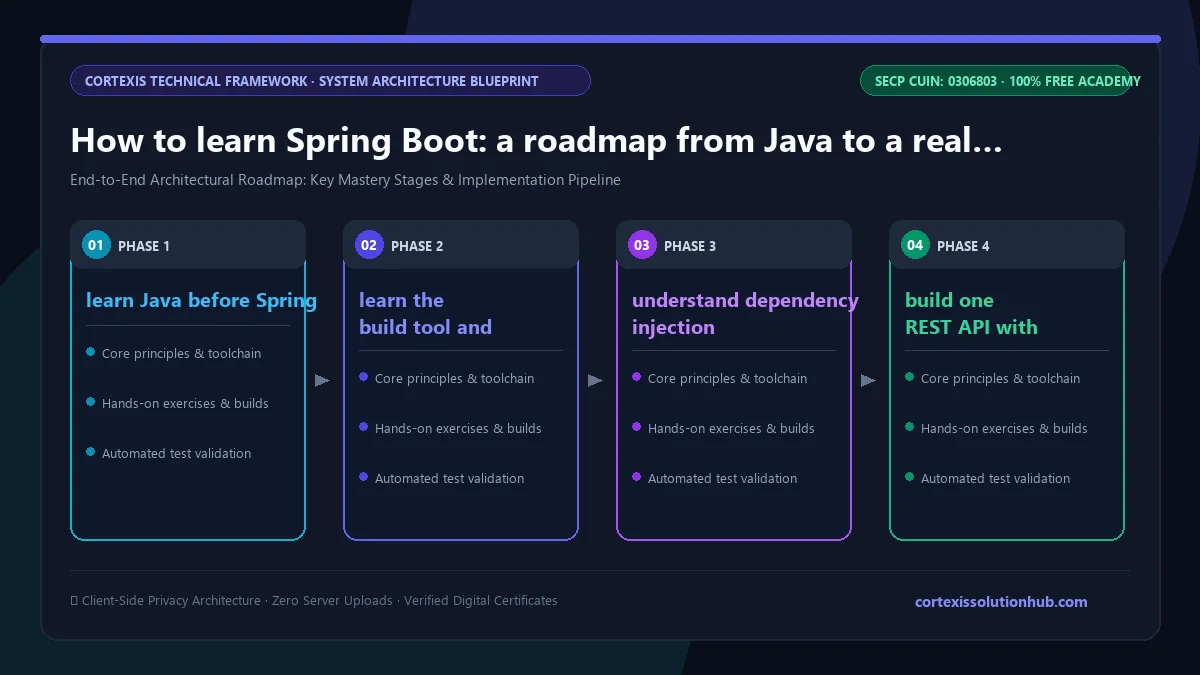
Step 1: learn Java before Spring
Spend real time on plain Java. Write programs with classes, constructors and records. Learn the difference between a List, a Set and a Map and when each is the right tool. Learn lambdas and the Stream API, because Spring code is full of them. Learn checked and unchecked exceptions, because your error handling later depends on it.
A good test: if you cannot write a method that takes a list of orders and returns the total per customer using streams, you are not ready for Spring yet. A few more weeks here saves months of confusion later.
Step 2: learn the build tool and testing early
Every Spring Boot project is a Maven or Gradle project. Learn what a pom.xml or build.gradle does, how dependencies are resolved, and how to run tests from the terminal. Write JUnit 5 tests for your plain Java code now.
Step 3: understand dependency injection
This is the idea Spring is built on. Instead of creating objects with new inside your classes, you declare what a class needs in its constructor, and Spring creates and passes it in. Once that clicks, @Service, @Repository and @Configuration stop looking like magic. Learn configuration and profiles at the same time, so the same code can run with different settings on your laptop and on a server.
Step 4: build one REST API with a real database
Pick a small domain you understand, like a library, a clinic queue or a shop's orders. Build controllers that accept and return DTOs, never raw entities. Validate input and return clean error responses. Store data in PostgreSQL with Spring Data JPA, add paging and sorting, and manage schema changes with Flyway migrations instead of letting Hibernate guess. If your SQL is weak, our SQL for data analysis course is a good companion, because JPA does not replace understanding the queries it runs.
Step 5: secure it, test it, ship it
Add Spring Security, hash passwords, and protect endpoints with JSON Web Tokens and roles. Write integration tests against a real PostgreSQL database with Testcontainers rather than an in memory stand in. Package the app as a runnable JAR, build a Docker image, and run it with Docker Compose alongside the database. If containers are new to you, how to learn Docker and Kubernetes explains the path.
Common mistakes when learning Spring Boot
Starting with Spring before Java. The framework will hide what it does, and you will not know which part of an error is yours.
Returning entities from controllers. It leaks your database shape into your API and causes lazy loading surprises. Use DTOs.
Ignoring relationships until they hurt. A one to many mapping that looks fine in a demo can fire hundreds of queries in a real list screen. Turn on SQL logging in development and read what runs.
Testing only with mocks. Mocks are useful, but a test against real PostgreSQL catches problems a mock never will.
Jumping to microservices. Splitting a small app into many services adds network calls, separate databases and harder consistency. Build one well structured service first.
What the free Java and Spring Boot course covers
The Java and Spring Boot course is written, not video, and is labelled beginner to intermediate. There are 12 chapters with 4 topics each, 48 topics in total, adding up to a little over 10 hours of reading. The course page suggests 8 weeks at a steady pace.
Chapter
What it covers
1. Java Foundations
Why Java runs the enterprise, installing the JDK and an IDE, your first program and compilation, variables, types and operators
2. Control Flow, Methods and Strings
Conditions and switch expressions, loops, methods and return values, String, StringBuilder and text blocks
3. Object-Oriented Java
Classes, objects and constructors, encapsulation and records, inheritance and polymorphism, interfaces, abstract classes and sealed types
4. Collections, Generics and Streams
Lists, sets and maps, generics, lambdas and functional interfaces, the Stream API
5. Robust Java
Exceptions, Optional and null safety, Maven and Gradle builds, unit testing with JUnit 5
6. Spring Boot Fundamentals
What Spring Boot solves, Spring Initializr, dependency injection and beans, configuration, profiles and application.yml
7. Building REST APIs
Controllers and request mapping, DTOs, validation and error responses, clean REST design, testing controllers with MockMvc
8. Data With Spring Data JPA
Entities and repositories, relationships, queries, paging and sorting, transactions and Flyway migrations
9. Application Architecture
Controller, service and repository layers, mapping entities to DTOs, logging and Actuator, caching and async work
10. Security With Spring Security
How the filter chain works, password hashing and registration, JWT authentication, roles and method security
11. Testing, Packaging and Deployment
Integration tests with Testcontainers, runnable JARs, Docker images, production configuration
12. Projects and Careers
Building a complete library API, when microservices help and when they hurt, interview preparation, careers for Java developers
Chapters 1 to 5 are pure Java, and if you already write Java at work you can move through them quickly. Chapters 6 to 11 are where Spring Boot lives. Chapter 12 ties it together in one project you can put on GitHub, which matters far more than finishing the reading. If Git is new to you, our Git and GitHub course covers what you need.
Who it is for, and how long it takes
It suits computer science students whose syllabus already uses Java, developers from other languages moving into enterprise backend work, and anyone aiming at banks, telecoms or software houses with Java stacks.
The first chapter starts from installing the JDK, so you do not need prior Java. It does help to have written some code before, in any language, so that loops and functions are not new ideas at the same time as Java syntax.
On time: the reading is a little over 10 hours, but reading is not the work. Building your own API alongside the lessons is where you actually learn. With an hour or so a day, the 8 week estimate is realistic.
How the quizzes and free certificate work
Each topic has a minimum reading time of 90 seconds before its quiz opens, and you need 70 percent on that quiz to unlock the next topic. Chapter quizzes are practice with instant feedback.
The certificate comes from the final exam: 50 questions, 60 minutes, one timed attempt, and you pass with 50 out of 100 marks. If you do not pass, a retake opens 30 days later with the questions and options reshuffled. Pass, and you get a free certificate with a verification code and a QR code anyone can check. Keep it in proportion, though. An interviewer at a bank or software house will be far more interested in a working API on GitHub with tests and a Dockerfile than in any certificate, ours included.
Ready to start? Open the free Java and Spring Boot course, install a JDK today, and get your first program compiling before you close the tab.
Questions, answered
06 questions
Yes. You do not need to master every corner of the language, but you need classes, interfaces, collections, generics, lambdas, streams and exceptions. Spring Boot is built on all of them, and without them its annotations feel like magic you cannot debug.
If you already know Java, building a simple REST API with a database takes a few weeks of steady practice. Starting from zero Java, plan on a couple of months to reach a secured, tested API.
For backend work at banks, telecoms, fintech companies and enterprise software houses, yes. Java systems tend to run for many years and need people to build and maintain them. It is a slower, steadier market than the JavaScript one, not a flashier one.
Learn Spring Boot, but understand the Spring ideas underneath it, especially dependency injection and beans. Spring Boot is Spring with sensible defaults, so learning it teaches you Spring as you go.
Not as a junior. Employers want you to build one clean, well tested service first. Understanding why microservices exist and what they cost is useful for interviews, and the course covers that trade-off in its final chapter.
Yes. The lessons, quizzes, final exam and certificate are all free. You need an account to track your progress and sit the exam.