09Consent, Server-Side Tracking, and First-Party Data
10Incrementality, Experiments, and Mix Modelling
11Retention, Cohorts, and Unit Economics
12AI Search, Platform Risk, and the Growth Model
Final exam
Certificate
48 topics · ~11h
Accredited Curriculum & Certification
Official Syllabus Snapshot
Direct Answer: Learn the whole growth stack the way it is actually run — funnel maths, keyword research, on-page and technical SEO, content, links, analytics, paid, email and social — with real numbers on every decision.
Tuition Fee
100% Free
Duration & Workload
~11 Hours
Curriculum Depth
12 Chapters · 48 Lessons
Credential Awarded
Verified Certificate
12Chapters
Course outline
The funnel maths that decides where to spend, the positioning that makes every channel cheaper, and the keyword research that follows from both.
The Funnel and the Numbers That Move It13 min
Positioning: Choosing Who You Are For12 min
Keyword Research and Search Intent15 min
Competitor Analysis and the Keyword Gap13 min
The elements on the page itself: what the title and description have to do, how headings and internal links carry meaning, and the markup that changes how your result looks.
Titles, Meta Descriptions, and Headings14 min
Internal Linking and Site Architecture13 min
Structured Data and Rich Results12 min
Images, Alt Text, and URL Slugs12 min
Getting found by the crawler, staying in the index, passing the speed thresholds, and winning the map pack.
Crawling, Indexing, Canonicals, and Sitemaps15 min
Core Web Vitals and Mobile14 min
Local SEO and the Map Pack13 min
JavaScript Rendering and Crawl Budget14 min
Planning and writing pages that earn their position, acquiring links you could defend in an audit, and reporting numbers that survive scrutiny.
Content Strategy and Writing That Ranks14 min
Link Building That Survives an Audit13 min
Analytics: Goals, Reports, and Attribution15 min
E-E-A-T and the Evidence a Page Carries13 min
Buying attention without overpaying for it, owning an audience nobody can take away, and using social for the job it is actually good at.
Paid Basics: Search vs Social, Bidding, and Quality Score15 min
Email Marketing13 min
Social Media Strategy12 min
Retargeting and Audience Building13 min
Finding the leak before you test anything, running experiments whose results you could defend in a meeting, and building landing pages that keep the promise the ad made.
Finding the Leak Before You Test It13 min
Running an A/B Test You Can Trust15 min
Landing Pages and Message Match13 min
Fixing the Checkout13 min
What to do when the graph falls off a cliff, how to move a site without losing the rankings you earned, and how to split a fixed budget between channels that all claim the credit.
Diagnosing a Traffic Drop14 min
Site Migrations Without Losing Rankings13 min
Splitting the Budget and Reporting It14 min
Forecasting and the Annual Plan14 min
The problems that only appear at hundreds of thousands of URLs and several markets: what the crawler really fetches, where the index fills with junk, and how one site serves many languages without competing with itself.
Log File Analysis: What Googlebot Actually Fetches14 min
Faceted Navigation, Parameters, and Index Bloat14 min
Building Thousands of Pages Without Building Junk13 min
Hreflang and Running One Site in Many Markets14 min
Rebuilding measurement for a world where a large share of visitors decline cookies: moving the tag onto your own server, feeding real revenue back from the CRM, and staying inside the rules while you do it.
Consent Mode and the Data You Never Collect13 min
Server-Side Tagging and the Conversion API14 min
Offline Conversions and Closing the CRM Loop14 min
First-Party Data and What You Are Allowed to Keep13 min
Separating the sales your marketing actually caused from the sales the platforms merely reported, using geo holdouts, mix modelling, and a calendar of tests that keeps both honest.
Why Three Platforms All Claim the Same Sale13 min
Designing a Geo Holdout Test14 min
Marketing Mix Modelling and Its Limits14 min
Calibrating the Model With a Year of Experiments14 min
Reading retention as a cohort curve, working out what a customer is worth after contribution margin and payback, and building the lifecycle programme that decides how much you can afford to spend acquiring the next one.
Cohort Analysis and the Retention Curve13 min
Contribution Margin, Payback, and the CAC You Can Afford14 min
Lifecycle Programmes: Onboarding, Reorder, and Win-Back13 min
Churn, Discount Dependence, and Customers Worth Losing13 min
What to do when the results page stops sending clicks, when one platform owns most of your demand, and when the growth model that got you here has run out of room.
AI Overviews, Zero-Click Search, and What Still Earns a Visit13 min
Getting Cited by AI Assistants, and Measuring It13 min
Platform Dependency and Concentration Risk14 min
Saturation, the Growth Ceiling, and Changing the Model14 min
Final exam & certificate
01
Topic checks
Each one opens the next topic
02
Chapter quizzes
Each one opens the next chapter
03
50-question final
50 of 100 marks to pass
04
Certificate
Issued instantly, verifiable
One attempt, 60 minutes. If you don't pass, you can retake once after 30 days.
The course guide
How to learn digital marketing for free, step by step
16 October 2026 · 10 min read
You can learn digital marketing for free if you learn it in the right order and practise on one real business the whole way through. Start with the numbers that decide where money should go, then learn search, because SEO teaches you how people actually look for things. After that come analytics, paid ads, email and social. Most free material online teaches these as separate tricks. The skill employers and clients pay for is knowing which one to use, and proving it worked.
This guide gives you a step by step roadmap, the mistakes that waste the most time, and an exact breakdown of our free Digital Marketing & SEO course, which follows the same order and ends in a free certificate.
What "digital marketing" actually covers
The term is wide enough to be useless, so it helps to split it into the jobs a marketer actually does:
Area
The question it answers
Strategy and positioning
Who are we for, and why should they pick us over the alternative?
SEO
How do people find us when they search, without us paying per click?
Content
What do we publish that deserves to rank and gets shared?
Analytics
Which of our efforts produced sales, and which only produced activity?
Paid search and social
How do we buy attention without overpaying?
Email
How do we reach people we already have, for almost nothing?
Social media
Where do we build familiarity and trust over time?
Conversion rate optimisation
Why are visitors arriving and then leaving without buying?
You do not need to master all eight, but you need to see how they connect.
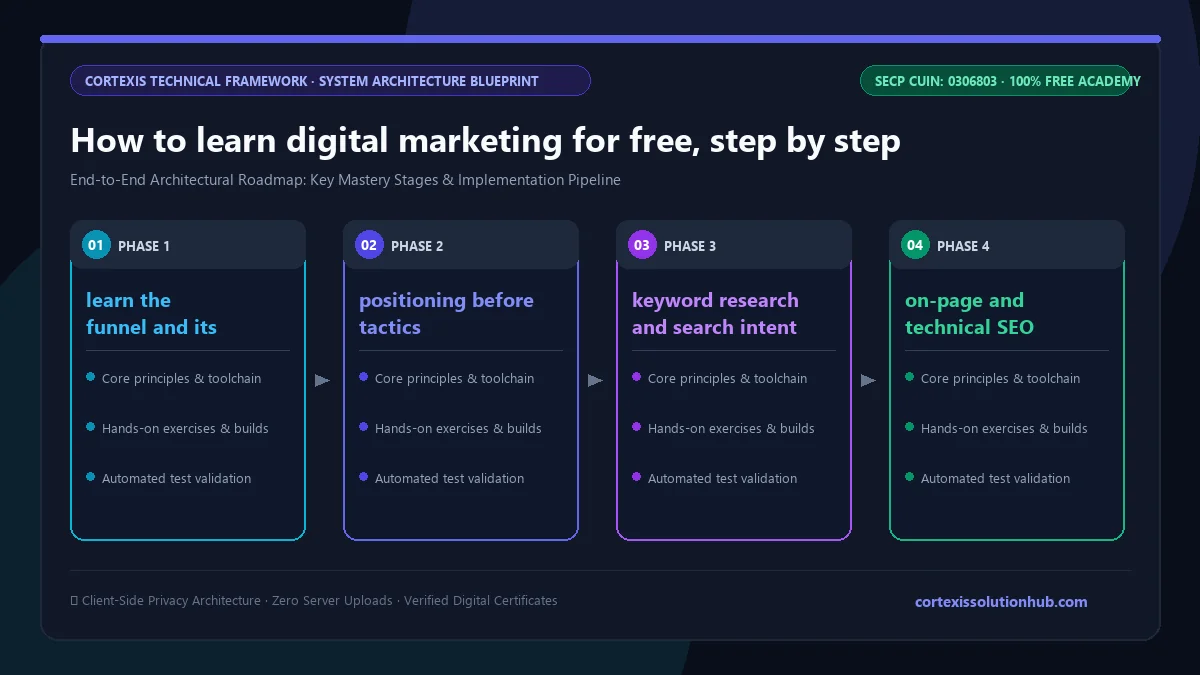
Figure 1: Complete step-by-step architectural workflow and technical execution stages for How to learn digital marketing for free, step by step.
How to learn digital marketing for free: the roadmap
Work through these in order. Each step depends on the one before it.
Step 1: learn the funnel and its numbers
Every campaign moves one number in a chain: people who saw you, visited, viewed a product, added to basket, started checkout, bought, and bought again. Write that chain down with real figures and many arguments answer themselves. If half the people who start checkout abandon it, buying more traffic just pays to fill a leaking bucket.
Step 2: positioning before tactics
Positioning is one sentence: who you are for, the one benefit, the alternative you beat, and the proof. It makes every channel cheaper.
Step 3: keyword research and search intent
Learn to read what a search result page is telling you. If every result for a query is a product page, Google has decided the searcher wants to buy, and a blog post will struggle there. If every result is a guide, a product page will struggle.
Step 4: on-page and technical SEO
Titles, meta descriptions, headings, internal links and structured data are the on-page part. Crawling, indexing, canonicals, sitemaps, Core Web Vitals and local search are the technical part. Use Google Search Console on any site you can get access to. It is free and it shows you what Google actually sees.
Step 5: content and links
Plan content in clusters around topics rather than one-off posts, and build links you would be comfortable explaining in an audit.
Step 6: analytics and attribution
Set up conversions in an analytics tool (Google Analytics 4 calls them key events) and learn why three different platforms can all claim the same sale. This is where many beginners stop, and it is exactly the skill that separates a marketer who reports activity from one who reports results.
Step 7: paid, email and social
Only now spend money. With tracking in place, you can tell whether an ad is profitable instead of guessing. Email and social round it out: email for the audience you own, social for familiarity and reach.
Pick one practice business and keep it
The single most useful thing you can do is choose one business and use it for every exercise. A relative's shop, a home baker on Instagram, a tuition centre, or a business you invent with realistic details. For it, you then:
Write its funnel with estimated numbers.
Write its positioning sentence.
Build a keyword map of twenty to thirty searches it should appear for.
Rewrite the title and description of its main pages.
Check its Google Business Profile, if it has a physical location.
Plan three months of content.
Draft a small paid campaign and a welcome email.
At the end you have a portfolio piece that shows thinking. If the business has no website yet, our post on what a website actually costs in Pakistan explains what goes into one, and you can build a simple one yourself with the free WordPress course.
Mistakes that waste months
Collecting tools instead of skills. Knowing ten SEO tools by name is worth less than understanding why a page is crawled but not indexed.
Starting with ads. Paid traffic sent to a page with a broken funnel teaches you only that ads are expensive.
Trusting one platform's report. Every ad platform grades its own homework. Compare against your actual orders.
Chasing volume over intent. A smaller search that matches what you sell beats a large one that does not.
What the free Digital Marketing & SEO course covers
The Digital Marketing & SEO course is rated Beginner and planned as eight weeks. It has 12 chapters and 48 lessons, about eleven hours of reading in total. You follow one example business, a coffee roaster called Riverbend, through every channel, with real numbers on every decision.
Chapter
What you learn
1. Strategy and Search Intent
The funnel and its numbers, positioning, keyword research and intent, competitor analysis and the keyword gap
2. On-Page SEO
Titles, meta descriptions and headings, internal linking, structured data and rich results, images, alt text and URL slugs
3. Technical SEO and Local Search
Crawling, indexing, canonicals and sitemaps, Core Web Vitals and mobile, local SEO and the map pack, JavaScript rendering and crawl budget
4. Content, Links, and Measurement
Content strategy, link building that survives an audit, analytics and attribution, E-E-A-T
5. Paid, Email, and Social
Search vs social ads, bidding and Quality Score, email marketing, social strategy, retargeting
6. Conversion Rate Optimisation and Testing
Finding the leak, running A/B tests you can trust, landing pages and message match, fixing the checkout
7. Traffic Drops, Migrations, and Budget
Diagnosing a traffic drop, site migrations without losing rankings, splitting the budget, forecasting
8. Large-Site and International SEO
Log file analysis, faceted navigation and index bloat, programmatic pages, hreflang
9. Consent, Server-Side Tracking, and First-Party Data
Consent mode, server-side tagging and conversion APIs, offline conversions, what data you may keep
10. Incrementality, Experiments, and Mix Modelling
Why platforms all claim the same sale, geo holdout tests, marketing mix modelling and its limits
11. Retention, Cohorts, and Unit Economics
Retention curves, contribution margin and payback, lifecycle emails, churn and discount dependence
12. AI Search, Platform Risk, and the Growth Model
AI Overviews and zero-click search, getting cited by AI assistants, platform dependency, growth ceilings
The first six chapters are the core a beginner needs. Chapters 7 to 12 go further than most free material does, into the problems that appear once a business is spending real money and the reports start disagreeing.
Every lesson has a short quiz and each chapter ends with a chapter quiz. The next chapter opens once you finish the lessons and pass that quiz.
Who this is for, and who it is not
It suits students who want a marketing job or internship, freelancers who want to offer SEO or ads services with more than guesswork behind them, and small business owners who want to understand what their agency is doing. You do not need to code, though a little HTML helps in the technical SEO chapter.
It is not a quick social media growth guide. If what you mainly want is to post better on Instagram, TikTok and Facebook, the Social Media Marketing course is the better starting point. If you want to sell these skills to clients, pair this course with Freelancing on Upwork and Fiverr.
How long it takes to learn digital marketing
The course is planned as eight weeks, with roughly eleven hours of lessons plus the time you spend on quizzes and your practice business. The first six core chapters are about five and a half hours of reading, so at an hour a day you can work through them, quizzes included, in two to three weeks. Being job ready takes longer, and what shortens it is a practice project with results you can show.
How the free certificate works
When you have completed every lesson and passed every chapter quiz, the final exam opens: 50 questions, 60 minutes, and a pass mark of 50 out of 100. You get one timed attempt. If you do not pass, a retake opens 30 days later, with the same questions in a new order and the options shuffled. Pass, and the certificate is issued free.
The certificate shows you finished a structured course and passed a timed exam. It is not a Google or Meta platform certification, and it will not replace a portfolio. We wrote more about what certificates are really worth in are free online certificates worth anything.
Ready to start? Open the free Digital Marketing & SEO course, pick your practice business, and work through chapter 1 this week.
Questions, answered
06 questions
Yes. The concepts, the free tools such as Google Search Console and Google Analytics, and courses like ours cost nothing. What you cannot get for free is experience, so practise on a real or realistic business from the start.
Learn the funnel and SEO basics first. SEO teaches you search intent and how pages work, and that makes you far better at paid search later.
No. Basic HTML helps with titles, headings and structured data, and the course explains the parts you need.
It is planned as eight weeks, with 12 chapters, 48 lessons and about eleven hours of reading, plus quizzes and a 50 question final exam.
No. It is a Cortexis certificate showing you completed the course and passed a timed exam. Platform certifications are separate and run by those companies.
Many beginners start with small local businesses or freelance projects. A portfolio showing a keyword map, page rewrites and a tracked campaign for one business will do more for you than a list of course names.