Direct Answer: Build reliable data pipelines from source to dashboard: SQL and Python for data work, batch and streaming ingestion, warehouses and lakehouses, dbt transformations, Airflow orchestration, data quality, and the practices that keep pipelines trustworthy in production.
Tuition Fee
100% Free
Duration & Workload
~11 Hours
Curriculum Depth
12 Chapters · 48 Lessons
Credential Awarded
Verified Certificate
12Chapters
Course outline
Understand what data engineers actually build, how the pieces of a modern data platform fit together, when batch and streaming each make sense, and how to choose tools based on needs rather than fashion.
What Data Engineers Do13 min
The Modern Data Platform13 min
Batch, Streaming and the Lambda Question13 min
Choosing Tools Without Chasing Trends12 min
Write analytical SQL with joins, window functions and CTEs, use Python and dataframe libraries for pipeline work, read from files, APIs and databases reliably, and structure data code so it can be tested.
Analytical SQL: Joins, Windows and CTEs14 min
Python for Pipelines: pandas, Polars and Beyond13 min
Working With Files, APIs and Databases13 min
Writing Testable Data Code12 min
Distinguish transactional from analytical modelling, design star schemas with facts and dimensions, track history with slowly changing dimensions, and choose between star schemas, wide tables and Data Vault for a given platform.
OLTP Versus OLAP13 min
Star Schemas: Facts and Dimensions14 min
Slowly Changing Dimensions13 min
Wide Tables, Data Vault and Choosing a Model13 min
Extract data from databases with full loads and change data capture, pull from APIs and SaaS sources reliably, decide between managed connectors and custom code, and load incrementally with watermarks while keeping backfills safe.
Extracting From Databases: Full Loads and Change Data Capture13 min
Pulling From APIs and SaaS Sources13 min
Managed Connectors Versus Custom Code12 min
Incremental Loads, Watermarks and Backfills14 min
Understand how cloud data warehouses work and what they cost, store data in lakes using columnar formats, use open table formats to bring warehouse features to the lake, and lay out data with partitioning and clustering for fast, cheap queries.
Cloud Data Warehouses13 min
Data Lakes and Columnar Formats13 min
Open Table Formats and the Lakehouse14 min
Partitioning, Clustering and File Layout13 min
Understand why ELT with dbt became the standard for transformation, build models with sources and refs, add tests, documentation and lineage, and structure projects with incremental models for scale.
The ELT Approach and Why dbt Won13 min
Models, Sources and Refs14 min
Tests, Documentation and Lineage13 min
Incremental Models and Project Structure13 min
Model pipelines as DAGs of tasks with schedules and data intervals, write production-ready Airflow DAGs, use sensors and backfills with idempotent tasks, and run Airflow reliably while knowing when an alternative orchestrator fits better.
DAGs, Tasks and Scheduling13 min
Writing Production DAGs14 min
Sensors, Backfills and Idempotent Tasks13 min
Airflow Operations and Alternatives13 min
Use Kafka to move event streams reliably, understand event time, windows, watermarks and state in stream processing, build a streaming pipeline from change capture to real-time features, and land streams in the warehouse or lakehouse.
Event Streaming With Kafka13 min
Stream Processing Concepts: Time, Windows and State14 min
Building a Streaming Pipeline13 min
Streaming Into the Warehouse12 min
Recognise how pipelines fail silently, test data for schema, freshness, volume and anomalies, agree data contracts and ownership with producers, and monitor, alert on and respond to data incidents like a production team.
Why Pipelines Fail Silently13 min
Testing Data: Schemas, Freshness and Anomalies14 min
Data Contracts and Ownership13 min
Monitoring, Alerting and Incident Response for Data13 min
Make warehouse queries fast by reading less data and joining wisely, keep cloud data bills under control, understand when and how to use Spark for distributed processing, and scale pipelines without breaking sources or production tables.
Query Performance in Warehouses13 min
Controlling Cloud Data Costs13 min
Spark and Distributed Processing14 min
Scaling Pipelines Safely13 min
Control access and protect sensitive data, make data discoverable with catalogues and lineage, serve data to BI tools, operational systems and applications, and prepare data correctly for machine learning and AI use cases.
Access Control and Sensitive Data14 min
Cataloguing, Lineage and Metadata13 min
Serving Data: BI, Reverse ETL and APIs13 min
Data for Machine Learning and AI13 min
Build an end-to-end pipeline project that demonstrates the full skill set, manage data infrastructure with code and CI/CD, prepare for data engineering interviews, and plan a career path in the field.
An End-to-End Pipeline Project14 min
Infrastructure as Code and CI/CD for Data13 min
Preparing for Data Engineering Interviews13 min
Careers in Data Engineering12 min
Final exam & certificate
01
Topic checks
Each one opens the next topic
02
Chapter quizzes
Each one opens the next chapter
03
50-question final
50 of 100 marks to pass
04
Certificate
Issued instantly, verifiable
One attempt, 60 minutes. If you don't pass, you can retake once after 30 days.
The course guide
How to become a data engineer: a practical roadmap
16 October 2026 · 10 min read
To become a data engineer, get very good at SQL first, then learn enough Python to move data between systems, then learn how analytics data is modelled, how it is loaded on a schedule, and how to tell when it has gone wrong. Build one pipeline that runs end to end, from a real source to a dashboard, and be able to explain every decision in it. Tools come last. Fundamentals are what get you hired and what keep you employed when the tools change.
Below is the order we would actually follow, how long it tends to take from different starting points, the mistakes that waste months, and how our free Data Engineering course maps onto each step, chapter by chapter.
What a data engineer actually does
Think of a digital wallet company in Karachi. Transactions sit in a production database, app events arrive from phones, support tickets live in one SaaS tool and campaign data in another. Someone asks "how many new users made a transaction within a week of signing up, by city?" No single system can answer that.
A data engineer makes it answerable. They extract data from each source, land it in a central store, clean and combine it into well modelled tables, schedule all of that to run reliably, monitor it so broken numbers are caught before a manager sees them, and serve the result to dashboards, analysts and models.
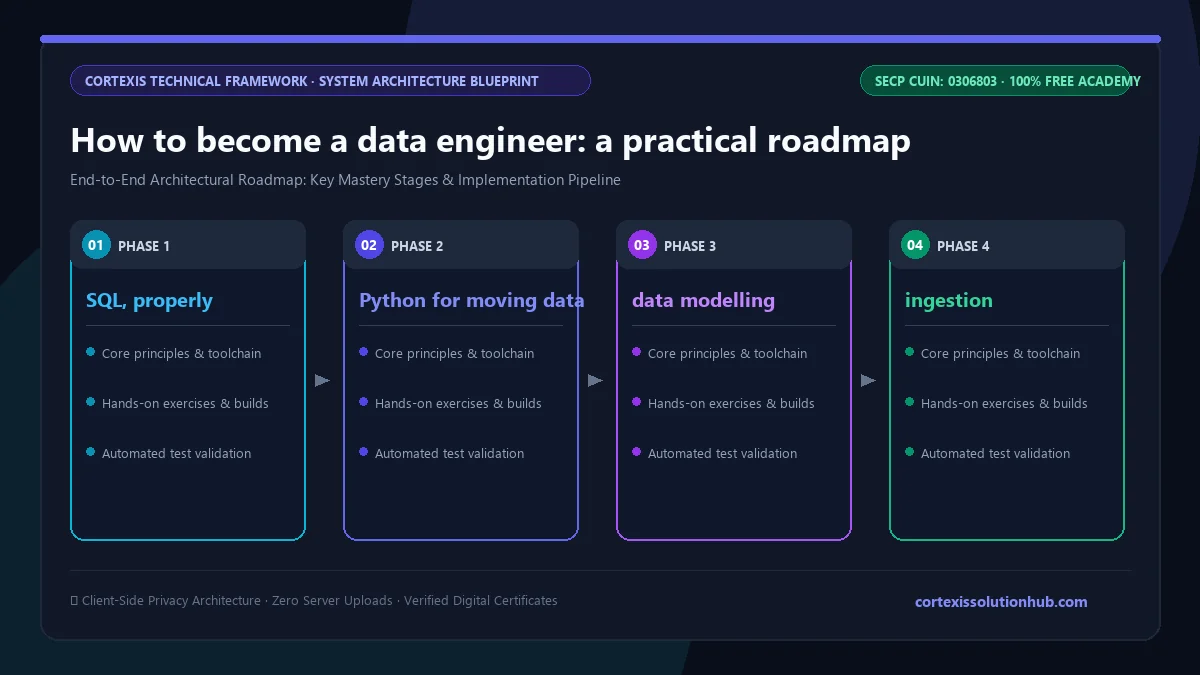
Figure 1: Complete step-by-step architectural workflow and technical execution stages for How to become a data engineer: a practical roadmap.
How to become a data engineer, step by step
Each step depends on the one before.
Step 1: SQL, properly
Joins of every kind, GROUP BY, window functions, CTEs, and the habit of checking row counts after every join. SQL is the core of the job at every level, from junior to staff. If your SQL is weak, our SQL for data analysis course is the place to fix it before anything else.
Step 2: Python for moving data
Read a file, call an API, write to a database, handle errors, and write code someone else can test. pandas is the starting point; Polars is worth knowing. If Python itself is new, take Python development first.
Step 3: data modelling
This is the step self taught people skip, and it shows in interviews. Learn the difference between transactional (OLTP) and analytical (OLAP) databases, star schemas with fact and dimension tables, and slowly changing dimensions, which is how you keep history when a customer moves city.
Step 4: ingestion
Full loads versus change data capture, pulling from APIs with pagination and rate limits, incremental loads with watermarks, and backfills when something has to be re run. Learn when a managed connector is the right answer and when custom code is.
Step 5: storage
Cloud data warehouses, data lakes, columnar formats like Parquet, open table formats and the lakehouse idea, and how partitioning and clustering decide whether a query is cheap or expensive.
Step 6: transformation and orchestration
dbt for turning raw tables into clean models with tests and documentation. Airflow for scheduling the whole thing as DAGs, with retries, sensors and tasks that are safe to run twice. You will see both named in many data engineering job posts, and the ideas behind them carry over to their alternatives.
Step 7: quality, streaming and the rest
Data quality checks, freshness monitoring and incident response. Then streaming with Kafka, performance and cost tuning, Spark, governance and access control. This is what makes a company trust you to run a pipeline, not just build one.
How long it takes
It depends on where you start. Treat this as a shape, not a promise.
Your starting point
What you already have
What to add
Data analyst
Strong SQL and business sense
Python, orchestration, engineering habits
Software engineer
Coding and systems skills
SQL depth, modelling, data tools
Database administrator
Deep database knowledge
Cloud, pipelines, modern tooling
Fresh graduate
Fundamentals, maybe some SQL
Everything above, plus one solid project
Analysts and developers often make the move in a few months of part time study, because half the skill set is already there. Graduates should plan for longer and spend most of it on the project.
Our course is listed at seven weeks and is aimed at an intermediate level, with around ten and a half hours of reading across 48 topics. The slow part is setting up a warehouse, breaking a DAG and working out why a join doubled your revenue.
The project that proves it
Employers do not hire certificates; they hire evidence. One end to end project beats five tutorials. A good shape:
Pick a source that changes over time: a public API, or a sample database you update yourself.
Ingest it incrementally on a schedule, not as a one off script.
Land it raw in a warehouse, then model it into a star schema with dbt.
Add tests: not null, unique keys, freshness, and at least one business rule.
Orchestrate it with Airflow and make every task safe to re run.
Put a simple dashboard on top.
Write a README that explains why you made each choice, what it costs to run, and what you would change at ten times the data.
In an interview you will be asked why, not what. The README is your rehearsal.
Mistakes that waste months
Learning tools before fundamentals. Spark on a laptop with a small file teaches you Spark's installer, not distributed processing.
Skipping modelling. A pipeline that delivers badly modelled tables just moves confusion faster. Star schemas and slowly changing dimensions come up in interviews often.
Pipelines that are not idempotent. If running a task twice doubles the rows, it will happen in production, usually on the day of a board meeting. Design every load so a re run gives the same result.
Failing silently. The worst data bug is not a crashed job; it is a job that succeeds with wrong numbers. Tests and freshness checks are part of the work, not an extra.
Ignoring cost. Cloud warehouses bill by what you scan or compute.
What the free Data Engineering course covers
The course is text with code and SQL you run yourself, not videos, and it uses worked examples from Pakistani businesses: wallets, telecoms, e-commerce and delivery. Here is what each of its 12 chapters covers.
Chapter
What you learn
1. The Data Engineering Landscape
What data engineers do, the modern data platform, batch versus streaming, choosing tools without chasing trends
2. SQL and Python for Data Work
Joins, window functions and CTEs, pandas and Polars, files, APIs and databases, testable data code
3. Data Modelling for Analytics
OLTP versus OLAP, star schemas, slowly changing dimensions, wide tables and Data Vault
4. Ingestion and Extraction
Full loads and change data capture, APIs and SaaS sources, managed connectors, watermarks and backfills
5. Storage: Warehouses and Lakehouses
Cloud warehouses, data lakes and columnar formats, open table formats, partitioning and file layout
6. Transformation With dbt
Why ELT and dbt won, models, sources and refs, tests and lineage, incremental models
7. Orchestration With Airflow
DAGs and scheduling, production DAGs, sensors and backfills, idempotent tasks, alternatives
8. Streaming Data
Kafka, event time, windows and state, building a streaming pipeline, streaming into the warehouse
9. Data Quality and Observability
Why pipelines fail silently, schema and freshness tests, data contracts, alerting and incidents
Access control and sensitive data, catalogues and lineage, BI and reverse ETL, data for ML and AI
12. Projects and Careers
An end to end pipeline project, infrastructure as code and CI/CD, interview preparation, careers
Chapters 1 to 7 are the core roadmap above. Chapters 8 to 12 cover running pipelines in production.
Who this path suits, and who it does not
It suits people who like making things reliable more than making things flashy: analysts tired of fixing broken spreadsheets, backend developers who enjoy databases, and graduates who want a technical role. Some companies abroad hire data engineers based in Pakistan remotely; strong written English and a public portfolio help most.
It suits you less if you want to build models rather than feed them. In that case, read our post on how to learn machine learning from scratch. If you are not yet sure you enjoy working with data at all, the Data Analyst Bootcamp is a gentler start, and plenty of data engineers began as analysts.
How the course and certificate work
Every chapter has four topics. Each topic has its own short quiz, and you need 70 percent on it to unlock the next topic. Each topic also has a minimum reading time of 90 seconds before its quiz opens. Each chapter then ends with a short quiz you must pass to open the next chapter.
The certificate comes from the final exam: 50 questions, 60 minutes, one timed attempt, and you pass with 50 out of 100 marks. If you fail, a retake opens 30 days later with the questions and options reshuffled. Pass, and you get a free certificate with a verification code and a QR code anyone can check. Be realistic about what it proves; we wrote about that in are free online certificates worth anything. Your project proves more.
Start with chapter 1 of Data Engineering: what data engineers actually build, and how the pieces of a modern data platform fit together. It is free, and you can finish the first topic today.
Questions, answered
05 questions
Yes. The skills are SQL, Python, modelling, pipelines and reliability, and all of them can be learned on your own. A degree helps with some employers' filters, but a working end to end project and the ability to explain it carry a lot of weight.
It is more technical. Analysts answer questions with data; data engineers build the systems that make the data trustworthy. Many people move from analysis into engineering because they already have the SQL and business sense, and add Python and pipeline skills.
No. Learn them after SQL, modelling, dbt and orchestration. Plenty of smaller companies never need them, and the ones that do expect you to understand the fundamentals first.
If you already work as an analyst or developer, a few months of steady part time study plus one solid project is realistic. Starting from scratch takes longer, because you need SQL and Python before the engineering parts make sense.
Yes. The lessons, quizzes, final exam and certificate are all free. You need an account to track progress and sit the exam.