
10 min read
Direct Answer: How to learn Node.js backend development step by step: the event loop, Express, validation, auth, databases and deploys, plus a free 12 chapter course.
- How to learn Node.js backend development step by step: the event loop, Express, validation, auth, databases and deploys, plus a free 12 chapter course.
- Authored by Umair with actionable, zero-fluff implementation guidance.
- Verified for immediate practical application, production workflows, and professional skill enhancement.
If you want to know how to learn Node.js backend development, start with JavaScript itself, then learn how Node runs your code, then build one HTTP API with Express that validates its input, authenticates users, talks to a real database and ships with logs and tests. That order matters. Most people who feel lost in Node are not confused by Express but by async JavaScript and the event loop, which every framework tutorial quietly assumes you already understand.
This guide gives you a roadmap that works, the mistakes that cost the most time, and an exact chapter by chapter look at our free Node.js Backend Development course, so you can decide whether it fits where you are right now.
What a Node.js backend developer actually does
A backend developer builds the part of an application that users never see: the API that the website or mobile app calls, the database behind it, and everything that keeps it running when real traffic arrives. In Node.js that usually means an HTTP server, most often built with Express, that receives requests, checks them, reads or writes data, and sends back JSON.
Writing the first working endpoint is the easy part. The real job is everything after that: rejecting hostile input, not leaking database connections, and keeping one slow handler from freezing the whole process. You are judged on whether the service stays up and stays correct.
What you need before you start
Node.js is JavaScript on the server, so JavaScript comes first. You do not need to be an expert, but you should be comfortable with:
- Functions, objects, arrays and array methods like
mapandfilter - Promises,
asyncandawait, and what happens when a promise rejects - Modules, meaning
importandexport - Basic HTTP: methods like GET and POST, status codes, headers, and JSON bodies
- Using a terminal and Git
A fair test: if you can write an async function that fetches two things in parallel with Promise.all and handles the error when one of them fails, you are ready. If not, spend a few more weeks on JavaScript. The frontend developer roadmap covers those JavaScript foundations.
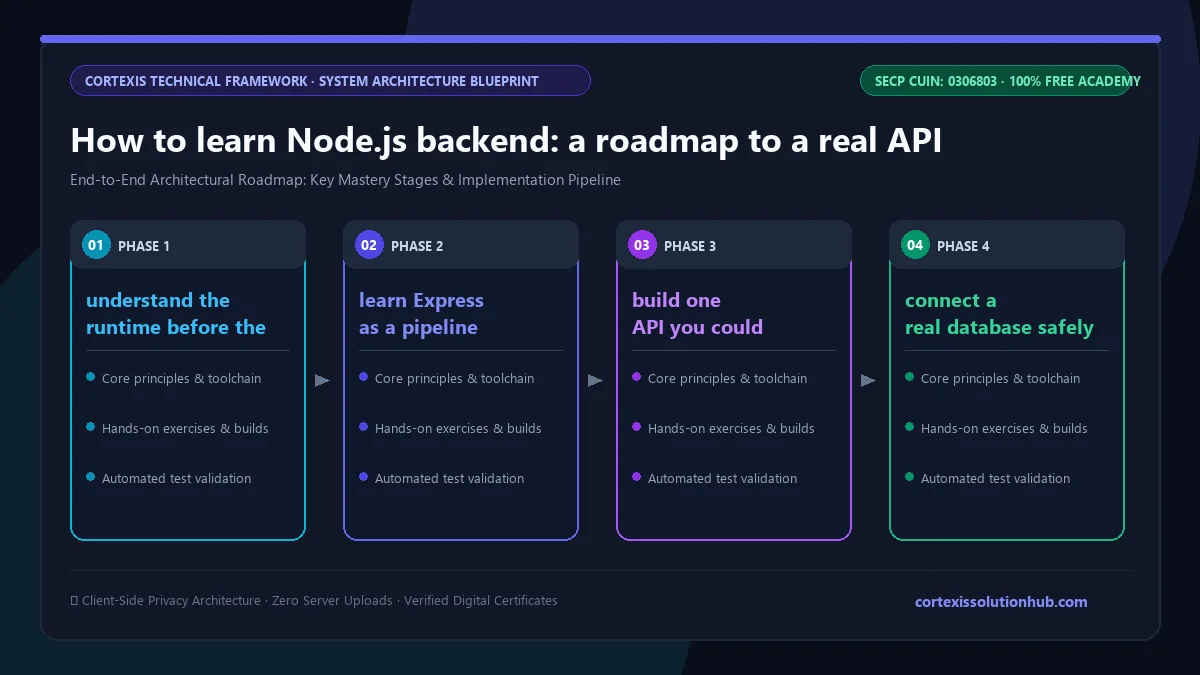
A step by step roadmap to learn Node.js backend
| Stage | Focus | You are done when |
|---|---|---|
| 1. The runtime | Event loop, modules, a raw HTTP server | You can explain why a synchronous loop blocks every request |
| 2. Express | Middleware order, routers, error handling, CORS | Errors return clean JSON and never hang a request |
| 3. A real API | REST design, validation, sessions or JWTs | Bad input is rejected at the edge, users can log in |
| 4. Data | Parameterised queries, transactions, migrations | No string built SQL anywhere in your code |
| 5. Production | Config, structured logs, tests, graceful shutdown | A deploy does not drop in flight requests |
Step 1: understand the runtime before the framework
Learn the event loop properly. Node runs your JavaScript on a single thread and hands slow work like file reads, database calls and DNS lookups to libuv. Non blocking does not mean fast. It means your thread is free while something else is slow. Build one HTTP server with no framework at all, using only node:http.
Step 2: learn Express as a pipeline
Express is a chain of middleware. Each one does exactly one of three things: responds, calls next(), or calls next(err). Doing two of them is what produces the familiar ERR_HTTP_HEADERS_SENT error. Learn why the order you register middleware matters, how routers split a project into parts, and how one central error handler keeps stack traces away from users.
Step 3: build one API you could defend
Pick a small domain you understand, like a clinic queue, a shop's orders or a tuition centre's attendance. Design predictable REST endpoints, validate every request body with a schema library such as Zod, and add authentication. Learn the honest trade off between server sessions and JWTs, and hash passwords with a deliberately slow, salted algorithm, never a plain fast hash.
Step 4: connect a real database safely
Use PostgreSQL and parameterised queries from day one. Learn transactions, and always release connections in a finally block. Manage schema changes with migrations instead of editing tables by hand. If SQL is new to you, our SQL for data analysis course is a good companion, because no library replaces understanding the queries it runs.
Step 5: make it production shaped
Read configuration from the environment and fail at startup if something is missing. Log structured JSON instead of loose console.log lines. Write tests that hit your real endpoints. Handle shutdown so a deploy finishes the requests already in progress. Package it in a container, and if that part is new, how to learn Docker and Kubernetes explains the path.
Common mistakes when learning Node.js backend
- Starting with a framework tutorial before async JavaScript. You will copy code that works until the first unhandled rejection, then have no idea where to look.
- Blocking the event loop. A heavy synchronous loop in one handler stalls every request on the server, not just that route.
- Trusting the request body. If you spread
req.bodystraight into a database update, a user can send arolefield you never meant to accept. - Building SQL with string concatenation. That is how injection happens. Use placeholders, always.
- Forgetting the error path. An async handler that throws without reaching
next(err)can leave a request hanging with no response.
What the free Node.js Backend Development course covers
The Node.js Backend Development course is written, not video, and is labelled intermediate. There are 12 chapters with 4 topics each, 48 topics in total, adding up to roughly 11 hours of reading. The course page suggests 8 weeks at a steady pace.
| Chapter | What it covers |
|---|---|
| 1. The Node Runtime | The event loop and non blocking I/O, modules and package.json, HTTP servers without a framework, the libuv thread pool |
| 2. Express in Depth | Routing and the middleware pipeline, routers and project structure, error handling that does not leak internals, CORS and preflight |
| 3. APIs, Validation, and Authentication | REST design, validating every request, sessions and JWTs, password resets and email verification |
| 4. Data, Streams, and Files | Querying a database safely, streams and buffers, safe file uploads, schema migrations without downtime |
| 5. Production Node | Configuration and structured logging, testing APIs, performance, clustering and deploying, migrations on a live deploy |
| 6. Diagnosing a Running Server | Profiling a slow process, memory leaks and heap snapshots, request context and stack traces, processes that refuse to exit |
| 7. Integrations and Background Work | Calling services that fail, background jobs and queues, trustworthy webhooks, long running requests and job status |
| 8. Caching, Limits, and Load Shedding | Cache headers and conditional requests, a shared cache without stampedes, rate limits and quotas, shedding load |
| 9. The Data Layer at Scale | Reading query plans, pooling across many instances, read replicas and lag, locks and hot rows |
| 10. Hardening a Public API | Hostile input that passes validation, tenant isolation, secret rotation, the dependencies you did not write |
| 11. Tracing, Metrics, and Service Levels | Tracing a request across services, useful metrics, SLOs and error budgets, running an incident |
| 12. Evolving a Live System | Versioning and deprecating an API, feature flags and canaries, the strangler pattern, dual writes and cutover |
Be honest about the shape of it. Chapters 1 to 5 are the core that every Node backend developer needs, and they are enough to build and ship a solid API. Chapters 6 to 12 are what separates someone who can write endpoints from someone you would trust with a service that real users depend on. Early in your career, finish the first five and build your project before rushing on.
Who this course is for, and how long it takes
It suits you if you already write JavaScript and want to move into backend work, if you are a frontend developer who wants to build your own APIs, or if you already use Express at work and want to understand why things break in production. If you want the whole picture, browser and server together, the full stack web course covers both sides, and TypeScript is worth adding once your Node code grows past a few files.
It is not the right first course if you are new to programming. Learn JavaScript first and come back.
On time: the reading is about 11 hours, but reading is not the work. Typing the examples, breaking them, and building your own API alongside is where the learning happens. With an hour or so a day, the 8 week estimate is realistic for a careful pass.
How the quizzes and free certificate work
Each topic has a minimum reading time of 90 seconds before its quiz opens, and you need 70 percent on that quiz to unlock the next topic. Chapter quizzes are practice with instant feedback.
The certificate comes from the final exam: 50 questions, 60 minutes, one timed attempt, and you pass with 50 out of 100 marks. If you do not pass, a retake opens 30 days later with the questions and options reshuffled. Pass, and you get a free certificate with a verification code and a QR code anyone can check. Keep it in proportion, though. An interviewer will care far more about a working API on GitHub with validation, tests and a clear README than about any certificate, ours included.
Start building
Pick one small API idea, set up a raw node:http server tonight, and work through the roadmap one stage at a time. For a structured path with quizzes at every step, start the free Node.js Backend Development course from Chapter 1.
Questions, answered
05 questions
Yes, especially for APIs that spend most of their time waiting on databases and other services, which is most web backends. It is a weaker fit for heavy CPU work inside the request, and the course explains exactly why and what to do about it.
Learn Express first. It is small, widely used and shows the middleware model directly, so other Node frameworks are quick to pick up afterwards.
If you already know JavaScript well, building a simple validated API with a database takes a few weeks of steady practice. Reaching an authenticated, tested API that you can deploy confidently usually takes a couple of months.
No, but learn basic SQL alongside it. You will write queries in almost every backend project, and understanding them is what keeps your API both fast and safe.
Yes. The lessons, quizzes, final exam and certificate are all free. You need an account to track your progress and sit the exam.