
PickParty
Unable to connect.
Could not connect to the game server. Please check your network connection and try again.
PickParty: how to play the online drafting party game
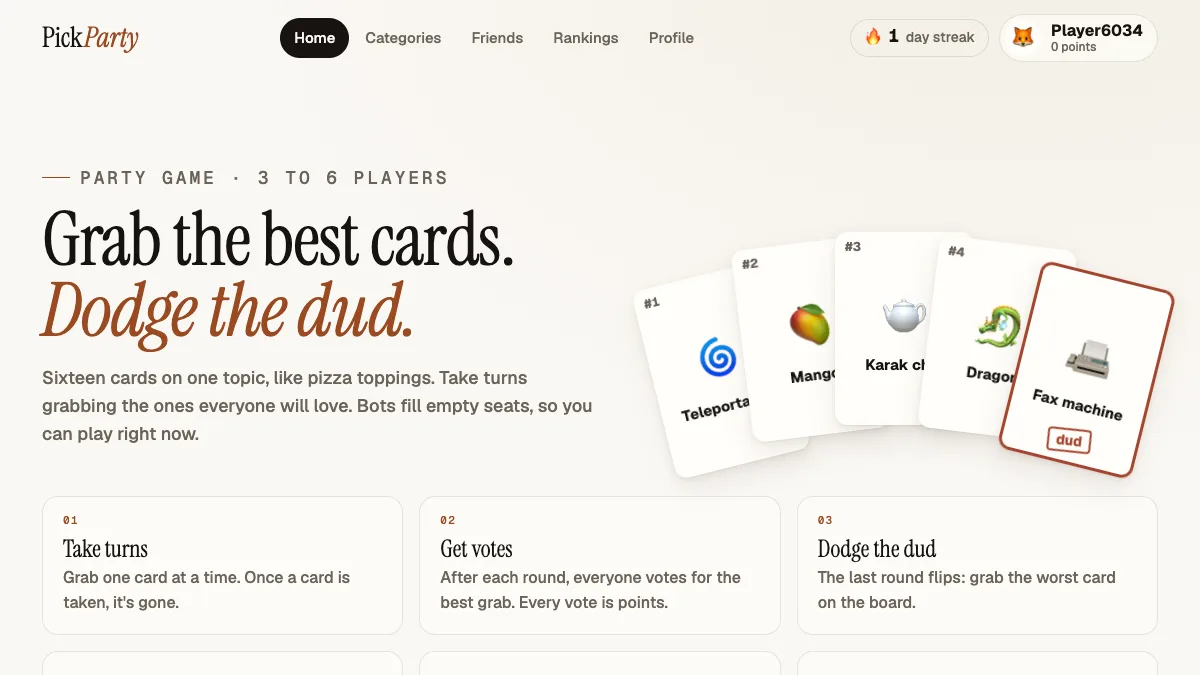
PickParty is a drafting party game for 3 to 6 players. Sixteen cards about one topic go on the board, and players claim them before anyone else can, by taking turns or, in Auction, by bidding. To start, pick a mode on the home screen and press Play. Then tap a topic (or Surprise me) and press Play again. Empty seats are filled with bots, so you never wait long for a game.
What "drafting" means
Drafting means taking turns to choose from a shared pile, a popular board game mechanic documented on BoardGameGeek's Open Drafting guide. Think of picking teams in the playground, but with cards. Every topic has sixteen cards. A topic might be pizza toppings or superpowers. When it is your turn, you tap one card and it becomes yours. Nobody else can take it now. There are 88 topics in the game.
You get a few seconds for each pick (12 by default). If you run out of time, the game picks a card for you, so the table never gets stuck.
| Mode | Players | Turn Mechanism | Scoring Strategy | Best For |
|---|---|---|---|---|
| Crowd Pleaser | 3–6 | Snake turn order | Vote predictions + Dud round | Casual groups & party warmups |
| Mind Reader | 3–6 | 1 Mind + Snake drafters | Find secrets (200/150/100 pts) | Bluffing & psychological play |
| Auction | 3–6 | Live 20-coin bidding clock | Lineup crowd score + Saved coins | Tactical budgeters |
| Crowd Read | 1 (Solo) | Timed card pick & lock-in | 3 lives, speed & combo multipliers | Quick solo brain training |
The snake order, explained simply
The order of turns is called a snake. It goes forward in one round and backward in the next.
Say four people are playing: Ali, Sara, Omar and you.
- Round 1: Ali, Sara, Omar, you.
- Round 2: you, Omar, Sara, Ali.
- Round 3: Ali, Sara, Omar, you again.
Going first is a big advantage, so the snake evens it out: whoever picked last in one round picks first in the next. A different player also leads off each new topic.
Who is "the crowd"?
You will see the word crowd a lot. The crowd is the game's ranking of every card in a topic, from best to worst. It starts from the order the topic was written in. Then it learns from real players. Every human vote in Crowd pleaser, and every secret a human picks in Mind reader, moves it a little. Bots read this ranking to make their choices, but they never change it.
Crowd pleaser: the mode to learn first
Crowd pleaser is marked "start here" on the home screen. Each topic has four rounds:
- Rounds 1 to 3: everyone grabs the card they think the whole table will love most.
- Round 4, the dud round: this one flips. A dud is a bad card. Now you grab the worst card on the board.
After every round, the table votes. In the first three rounds you vote for the best pick. In the dud round you vote for the worst dud. You cannot vote for your own card.
Scoring is simple:
- Every vote your card gets is worth 100 points.
- The most-voted card of the round earns a 50 point bonus. If cards tie for most votes, they all get it.
Whoever scores the most points on a topic wins that topic. When the match ends, the player who won the most topics wins the table. If two players won the same number of topics, total points decide it.
Tip: grab the card you think everyone else will vote for, not just your own favourite.
Mind reader: guess one player's secret
In Mind reader, one player on each topic is the Mind. The role moves around the table from topic to topic.
The Mind secretly chooses three cards they love, in order (1st, 2nd and 3rd), and one dud. They get 20 seconds. If time runs out, the game picks a secret for them. Everyone else then drafts three cards each in snake order, trying to grab the Mind's loves.
At the reveal:
- Grabbing the Mind's 1st love scores 200, the 2nd scores 150, and the 3rd scores 100.
- If you grabbed the Mind's dud, you score zero for the whole topic.
- The Mind earns 75 points for every love that somebody found.
Being easy to read pays. As in the other modes, the highest score on a topic wins it.
Auction: bid coins instead of taking turns
Auction has no turns. Everyone gets 20 coins for each topic. The sixteen cards come up for sale one at a time. Cards still waiting stay face down.
How bidding works:
- The first bid is 1 coin. Every raise must beat the top bid.
- A card opens with a 10 second clock. A new bid tops the clock back up to 6 seconds if it was lower. No card stays open longer than 30 seconds.
- When the clock runs out, the top bidder takes the card. If nobody bids, the card stays on the board.
Your lineup is the set of cards you end up owning for the topic. It has a limited number of slots: four cards with three or four players, three cards with five players, and two cards with six. Any empty slots get leftover cards for free at the end.
Then comes the reveal. Each card is worth 10 to 160 points, depending on how high the crowd ranks it. You also get 5 points for every coin you did not spend. Highest total wins the topic.
Crowd read: the solo mode
Crowd read is for when you want to play alone. On each topic you guess the crowd's top three cards and its dud before the clock runs out. Tap three loves first, then the dud, then lock in. The tray labels your loves 1st, 2nd and 3rd, but the order does not change your score.
- A hit is a correct guess. A love is a hit if it is in the crowd's top four. The dud is a hit if it is in the bottom four.
- Get at least two hits and you survive the topic. Fewer than two and you lose one of your three lives.
- Your combo is a streak of good topics. Each topic with three or more hits grows it, and a bigger combo multiplies your points, up to two times. A topic with fewer than three hits resets it to zero.
- The clock starts at 20 seconds and drops by one second every topic, down to 10.
- Locking in quickly earns a small speed bonus.
The run ends when your lives are gone. Your best run shows on the home screen.
Culture, topics and match length
On the home screen you choose a culture:
- Desi plays packs like biryani, Eid and shaadi, plus the shared packs.
- Global plays things like the NBA, Disney and Fortnite, plus the shared packs.
- Mix plays everything, including packs that blend both, like Comfort food and Singers.
Next to it you choose how long a match is: 1, 2 or 3 topics. Both choices are remembered in your browser.
Want certain topics? Open the categories and tap the ones you want, in order. You can pick as many as your match length allows, so one pick for a 1-topic match and up to three for a 3-topic match. Then press Play. The match opens on your first pick. Any topic you leave empty is drawn at random.
Bots, quick matches and private tables
Quick matches are public and ranked. Ranked means your result adds points to the Rankings boards. The lobby waits about 10 seconds, then bots fill the empty seats up to four players. Bots play from the crowd ranking with a little randomness.
Private tables are for friends. Go to Friends, press Start a table, and you get a five-letter code and an invite link to share. Your friends enter the code or open the link to join. As the host you choose the mode, the culture and the topics, and you can add or remove bots. You need at least three seats, bots included, to start. Private tables do not change the rankings. After a match, everyone goes back to the lobby, ready for another round.
You do not need an account. Your player card is your profile: your name, avatar and country. You can edit it on the Profile page, and it is saved in your browser.
More games to try
TypeDash is a live typing race you can play with friends, and Gotcha Rush asks you to guess what a piece of code prints. You can find all of them on our free games page.
Questions, answered
05 questions
A table plays with 3 to 6 seats. You can still play alone, because bots fill empty seats in quick matches, and a host can add bots to a private table. There is also the solo mode, Crowd read.
It is a turn order that goes forward in one round and backward in the next, which keeps things fair.
The dud is the worst card on the board. In Crowd pleaser, the fourth round asks everyone to grab their worst card, and the table votes for the worst one. In Mind reader, grabbing the Mind's dud zeroes your score for that topic.
Go to Friends, press Start a table, and share the five-letter code or the invite link. Friends who enter the code or open the link join your table. You pick the mode and topics, then start.
No. It runs in your browser and there is no account to make. Your player card (name, avatar and country) is saved in the browser you play on.